
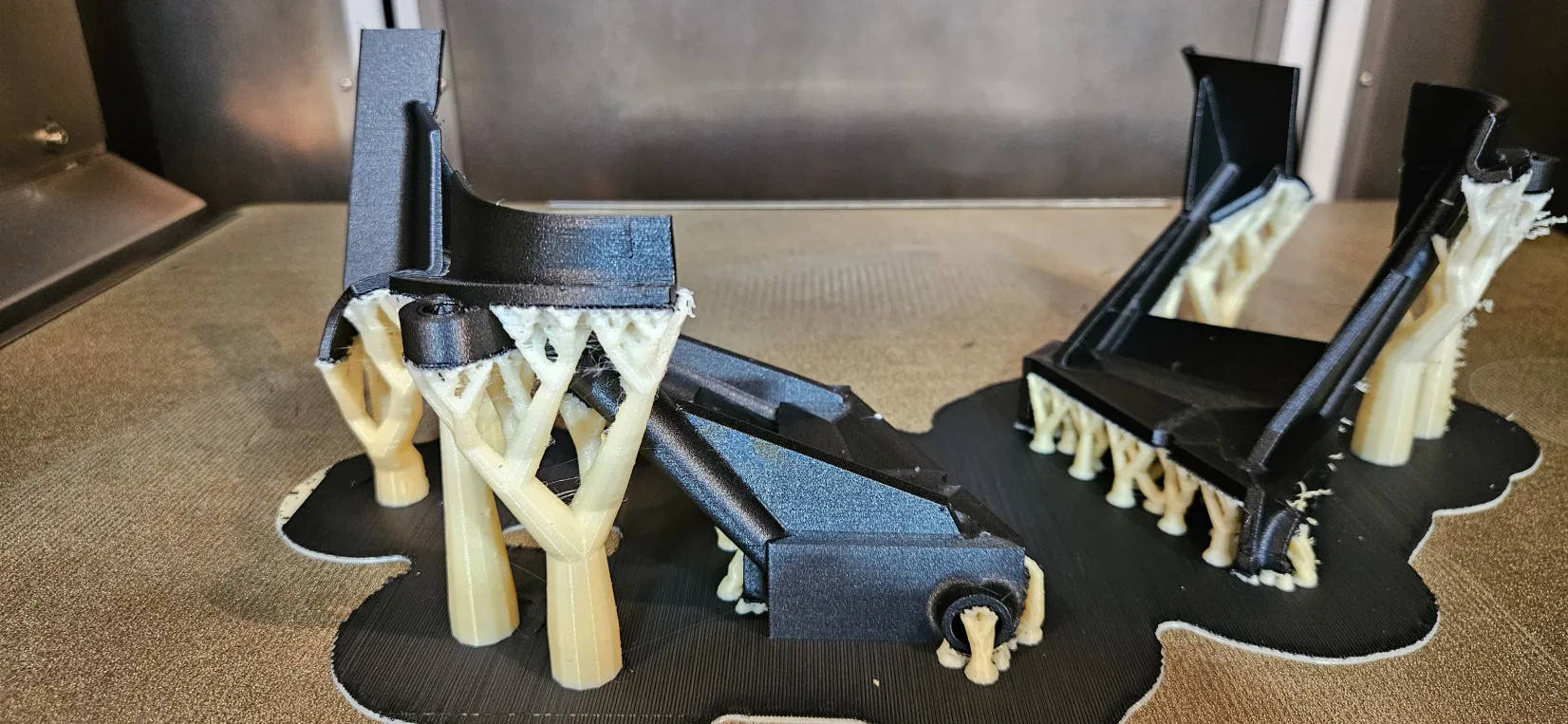
Additive manufacturing has helped MCT Engineering accelerate the production of high performance carbon fibre components for leading marques.
Brands such as Aston Martin, BMW, Cosworth, JLR, McLaren, and Mercedes Benz have long relied on the company’s expertise in crafting precision body parts for hypercars and Formula 1 vehicles. The headquarters in Daventry, Northamptonshire, boast five advanced autoclaves and a skilled workforce of over a hundred technicians, CAD operators, and designers.
In 2019, MCT Engineering took a bold step towards innovation by collaborating with an external provider to incorporate industrial 3D printing into its process. The aim was to enhance the manufacture and assembly of crucial parts—brake ducts, engine plenums, body panels, bumpers, oil tanks, and wing mirrors—used in high-performance vehicles. This move reflected a company-wide culture of continuous improvement, honed over decades of experimentation and dedication.
Gwyn Roberson, Innovation and Futures Director at MCT Engineering, remembers the pivotal moment clearly. "We invested in 3D laser scanning in 2023," Gwyn explained. "It was time to bring 3D printing in-house, so we could have greater design control and a wider choice of materials. We started researching industrial 3D printers, looking closely at the range of printable materials and how they performed compared to our existing methods."
Before committing to a machine, the team spent months testing the capabilities of various industrial 3D printers and materials. High-performance engine components had to be assembled with extraordinary accuracy and tight tolerances, so every detail mattered. Felix Schwarz, one of the production engineers, explained the challenges faced. Previously, when assembling high-precision engine parts for hypercars, MCT Engineering would fabricate custom jigs and fixtures to ensure perfect placement. The old method involved encasing the part in wet lay fibre composites, allowing the block to cure overnight, then removing it. But the team wondered if 3D printed jigs could match—or even surpass—this accuracy.
"You’ll always get some shrinkage," Felix reported, "but we’ve been exploring new printable materials for more consistency." The team experimented with fibre-reinforced PEEK, Ultem™ 1010, fibre-reinforced nylon, and other high-temperature filaments, learning how each material behaved and whether it could withstand the rigours of their demanding work.
After narrowing the search to two leading manufacturers, Gwyn encountered Grant Cameron, managing director of CDG 3D TECH, at a trade show. The display of components printed using the Intamsys Funmat Pro 610 HT 3D Printer caught Gwyn’s attention, and soon intensive trials followed. These trials allowed MCT Engineering to fully explore the range of materials and thermal properties possible with the Funmat Pro 610 HT.
Felix explained why the team ultimately chose the Funmat Pro: "Even with larger printers, accuracy can drift so you end up readjusting the jigs manually. The Funmat’s open-source platform let us lower material costs, and it consistently delivered higher accuracy than other printers."
The industrial 3D printer opened new possibilities for MCT Engineering’s staff. They could now experiment hands-on with materials like fibre-reinforced PEEK, Ultem™ 1010, and other high-temperature filaments. Felix was surprised to find that these advanced materials could be printed and then autoclaved at 130-150°C, resulting in stable structures for jigs, moulds, and low-volume tooling. However, he noted that many high-temperature filaments are hygroscopic, absorbing atmospheric moisture and becoming softer over time, which can affect accuracy.
To ensure the adoption of best practices, CDG 3D TECH’s specialists provided a day and a half of training at the Daventry factory, covering installation, setup, and software. Felix recalled, "We’ve had great support from CDG 3D TECH—they installed everything and trained us up. Over the last eighteen months, we’ve learned how each new material works, their strengths and limitations, even which solvents to use to keep parts from lifting during printing."
Printing high-temperature polymers proved difficult at times, especially with fibre-reinforced PEEK. "It’s probably one of the most challenging filaments to print," Felix admitted. Still, the training and support proved invaluable, helping the team overcome hurdles throughout the adoption process.
Miles Cameron, CDG 3D TECH’s business development manager, reflected on the transformation at MCT Engineering: "They’ve taken the next step beyond traditional polymer and metal CNC machined mould tooling. Industrial 3D printing gives them versatility, lowers costs, and speeds up project completion."
MCT Engineering’s journey was marked by constant exploration. One trial project involved printing an extractable core for carbon fibre pipes and ducts, which resulted in a smooth internal surface—an improvement over the traditionally rough interiors of carbon-fibre parts. This innovation meant that hollow components like brake ducts now featured both smooth inner and outer surfaces, optimising airflow and cooling and opening up new business opportunities.
Felix emphasised another key benefit: producing components directly from CAD files meant MCT Engineering’s staff could deliver parts with consistent accuracy and high quality. Rapid prototyping became possible, allowing clients to see and test new designs faster than ever before.
Time savings were also significant. Traditionally, it could take between 48 hours and a week to pattern, tool, and produce a carbon-fibre component using conventional methods. Now, with the Intamsys Funmat Pro industrial 3D printer, a standard part could be completed in up to 24 hours, while a smaller mould could be made and autoclaved within 8 hours. Comparing processes, Felix explained that 3D printing a part took between 12 and 24 hours, depending on size and complexity, which offered a marked improvement.
Ultimately, MCT Engineering’s investment in industrial 3D printing enabled the company to save costs by bringing previously outsourced work in-house. It also gave more employees the chance to gain hands-on experience with cutting-edge technology, ensuring the consistent high quality of the hypercar and racing car components they produced.
Gwyn Roberson summed up the transformation: "Investing in our own industrial 3D printer, with the training and support of CDG 3D TECH, has helped us save time, print components more economically, and de-risk new projects. It’s opening up new possibilities for our business to grow."