
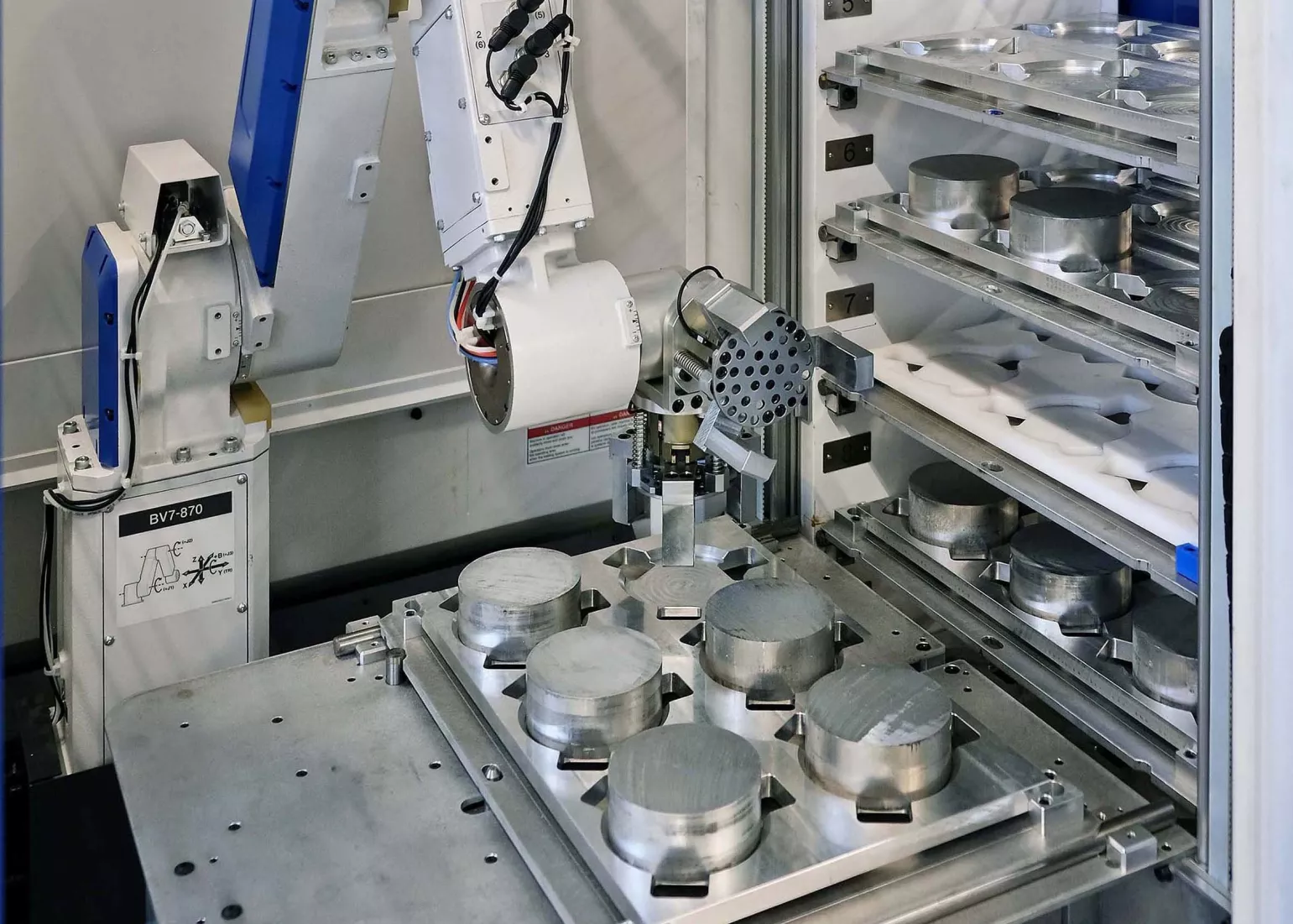
An automated mill-turn cell from is allowing JWA Tooling to maximise output with its existing shift pattern.
A shortage of skilled engineers and a desire to continue with single day shift operation over an existing pattern of a four-day working week have all played a part over the past five years in prompting JWA to research the best way to automate its production. It led in early March 2023 to the purchase of a Brother 30-taper M200X3 mill-turn centre with integrated BV7 component stocker and robotic handling.
Mainly serving the aerospace and defence industries as well as the emerging hydrogen fuel cell sector, JWA produces a lot of prismatically machined components in non-ferrous materials such as aluminium, stainless steel, copper, brass and plastics, often to single-figure micron tolerances. They are required in relatively limited quantities in the range 30- to 100-off, sometimes fewer if they are for R&D projects, so the company needs automated production systems that are fast to change over to a new batch run.
Pete Wood, Operations Director at JWA said, "Automation of lathes is easy using bar magazines and we have numerous such turning cells on our shop floor. However, autonomous production of milled components is more problematic because of the high diversity of shapes and small batch quantities.
"The typical selling price of prismatic parts going through our factory does not justify the purchase of a machining centre with a pallet storage and retrieval system, as they tend to be expensive and are also space-hungry. So robotic handling of the components themselves into and out of the machining area was a necessity."
An early move towards this type of automation to compete with manufacturers in low-wage countries was made three years ago when the company decided to add a 6-axis cobot to a 4-axis BT40 machining centre on the shop floor. Operating with a single tray of parts, it works well unattended but has a couple of drawbacks. First, it is relatively slow to exchange a finish machined component for a new billet, taking around 3.5 minutes; and second, the automation takes up a lot of space.
In contrast, the Brother system avoids both of these negatives by executing component exchange in well under half a minute and by compressing the machining centre complete with its automation into a 3.5 metre x 4.1 metre footprint, only a little larger than that occupied by the cobot alone. With space at a premium at the Leicester facility, the compactness of the new cell is an important plus-point.
The Brother M200X3 has a face-and-taper spindle and a torque table capable of turning components in the same set-up. Several parts produced by JWA CNC require pre-turning before prismatic machining, so there will be a saving by performing both operations on the Brother, especially if the subsequent 5-axis milling and drilling allows parts to exit the machine in fewer set-ups, or perhaps even one.