
Medical equipment manufacturer Hollingsworth Design Ltd (HDL) brought its milling and turning in-house and started its own subcontract machining division.
The first CNC lathe and mill were installed in 2017, followed by another turning centre and then a German-built Index G200 twin-spindle, triple-turret, turn-mill centre supplied in 2020 by sole agent Kingsbury.
Since then, the number of lathes and mills on-site has doubled to eight, including a smaller capacity Index C100 and HDL’s first automated prismatic machining cell, a robot-fed, five-axis, HSK-A63 spindle C12 from Hermle, Germany, also represented exclusively in the UK by Kingsbury.
The same period has seen the arrival of a CNC mitring saw, an Aberlink coordinate measuring machine, a Keyence optical inspection system and the company’s first quality control inspector, Simon Tweedie. Other new members of staff are Richard Binks, who is dedicated to subcontract sales, and Nick Mort, lead engineer in charge of the CNC section.
Mr Mort commented, “The subcontract side of our business has increased fivefold to 25% of turnover in the last two years and we are aiming to increase it to 50% by 2026.”
The 65 mm bar capacity Index G200, which is fitted with a three-metre bar magazine, is playing a major role in fulfilling the growing number of contracts. The upper, double tool carrier has a 360-degree B-axis and a ± 65 mm Y-axis. On one side there is a 14-station, live tool turret rated at 16 kW / 16 Nm (25% DC) and 7,200 rpm maximum speed. On the other side there is an HSK-A40 22 kW / 52 Nm (25% DC) milling spindle with automatic cutter exchange, enabling considerable machining versatility in combination with the two lower turrets that also serve the 6,000 rpm / 32 kW main and counter spindles.
Arranged in mirror image, each lower turret has an independent, ± 45 mm Y-axis and an identical rating to the turret at the top. To optimise productivity, it is possible to utilise all three turrets simultaneously at either the main or counter spindle, without interference. Alternatively, simultaneous machining the front end of a component at the main spindle and the reverse end at the counter spindle, in contrast to sequential machining on HDL’s earlier lathes, has cut cycle times dramatically. To produce a typical turned, threaded and engraved brass manifold component, for example, the typical cycle time has been reduced from 4 to 1.5 minutes and similar efficiency is gained when producing subcontract parts for other OEMs.
Given the lathe’s high power and versatility, it is not surprising that there was a tendency to prioritise the use of this Index turn-mill centre when considering which machine to employ for producing a new or existing part, even if it mostly entailed prismatic machining using the driven tools. So another lathe from the same source, an Index C100 having 42 mm bar capacity and a more conventional three-turret configuration, was bought to produce most of the turn-milled components for internal use, freeing the larger lathe to fulfil subcontract work, which is often more complex and generally larger.
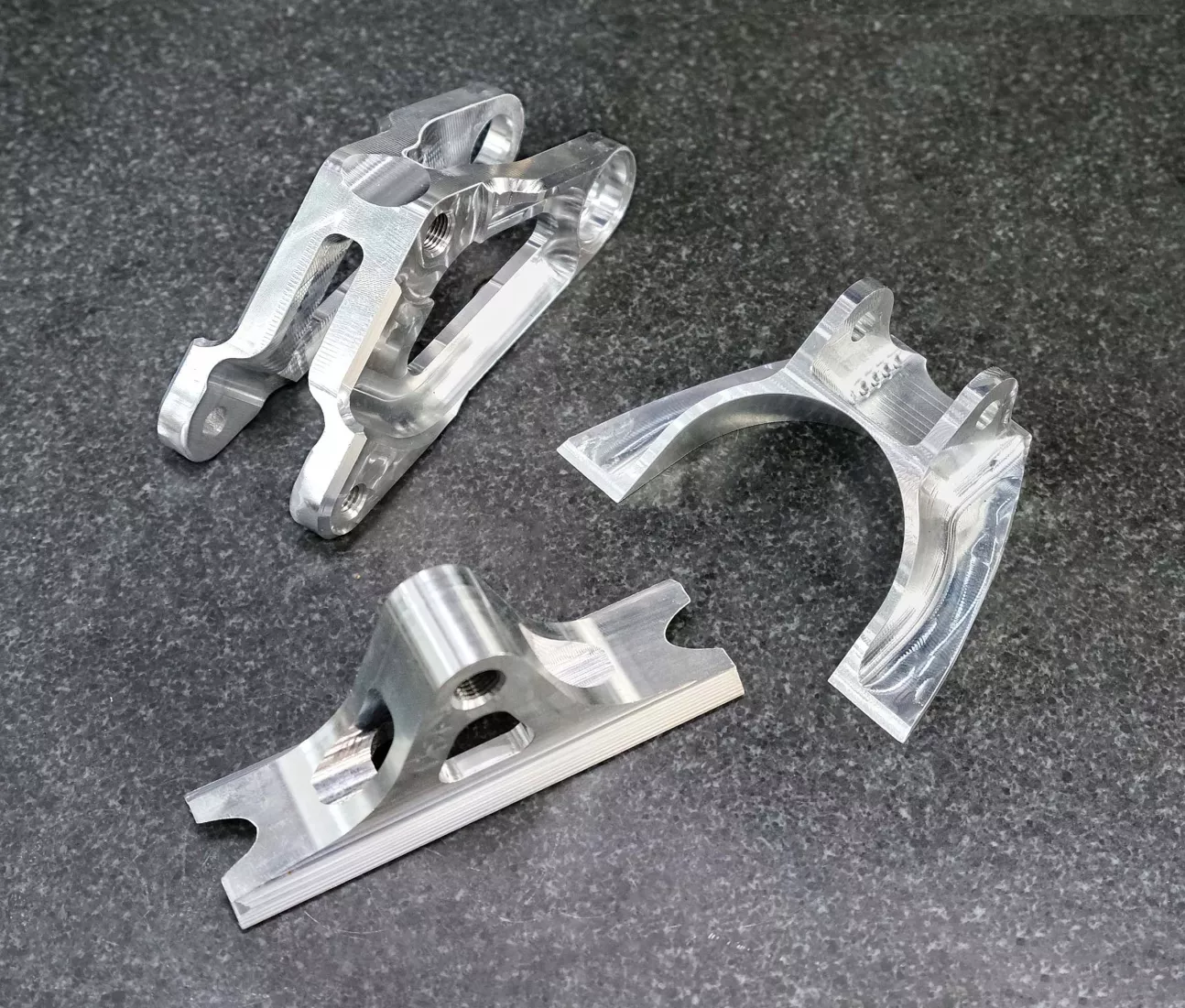
In early 2023 when HDL wanted to acquire its first automated machining centre, it selected Kingsbury again for the purchase of the Hermle cell. This complemented a stand-alone 5-axis machine that was being used almost exclusively for producing aluminium parts for a bicycle manufacturer in the north of England. The contract was growing in variety and volume, especially with the introduction of an electric bike, so automation was the obvious choice for producing the parts more cost effectively.
As the bicycle components are relatively light, it was decided that a Hermle RS05 robot for handling individual billets into the machining area and returning finished parts was preferable to automated pallet exchange. The latter would have incurred more cost to buy the pallets and workholding equipment and entailed extra work for fixturing parts and removing them.
Now production of the bicycle parts is shared between the 30-taper machine and the Hermle. Prototypes are produced on the former, while larger batches are put onto the latter; 50-off, say, if piece part cycle time is 15 to 20 minutes, or 200-off minimum in the case of shorter cycles.