
A new Knowledge Transfer Partnership between Aston Business School and Metal Assemblies, a specialist manufacturer of pressed and assembled metal components, aims to develop the UK’s first method for measuring and reporting the carbon cost of automotive parts.
This ground-breaking initiative comes as new environmental regulations, such as the EU Carbon Border Adjustment Mechanism, require precise carbon data for vehicle components and impose tariffs on carbon-intensive goods.
Aston Business School will work with West Bromwich-based Metal Assemblies to calculate and report the carbon footprint of every metal component used in car production, addressing a major sustainability challenge for the industry. Metal Assemblies, which supplies brands including Toyota, BMW, and Nissan across the UK and Europe, hopes the three-year Knowledge Transfer Partnership (KTP) will transform manufacturing standards and encourage low-carbon approaches throughout the supply chain.
Through this KTP, Metal Assemblies gains access to specialist expertise in data analysis and operations. The project will design and integrate innovative strategies for energy efficiency throughout the company’s manufacturing process, helping Metal Assemblies position itself as the first in the sector to provide detailed carbon cost information. By collecting and analysing energy consumption data based on product life-cycle analysis, the partnership will create a sustainable manufacturing strategy. This will enable the company to market its products and processes according to their carbon content and trade-offs.
The team will also apply Aston University’s Sustainability Fitness concept, which measures a company’s sustainability health and identifies cost-effective improvements to maintain competitiveness and regulatory compliance. Working with customers to design more sustainable components, Metal Assemblies will help the wider sector adopt alternative, lower-impact manufacturing techniques. This project builds on a previous KTP focused on digital transformation and automation for Metal Assemblies.
Iain Collis, CEO of Metal Assemblies, stated: “There isn’t yet a structured, robust approach in the automotive supply chain for measuring the carbon cost of parts and reporting this up the chain to customers. By working with Aston Business School to develop a systematic method for assessing environmental impact, we’ll be transforming this end of the supply chain in ways that provide value to our customers while differentiating ourselves from our competitors.”
Dr Breno Nunes, reader in sustainability operations management at Aston Business School, added: “Through the Corporate Sustainability Fitness Model, we’ll be providing Metal Assemblies with a visual dashboard that clearly shows the company’s sustainability performance, trade-offs of each potential shift in their strategy, and a clear direction to take for a more sustainable future. This offers a new way to think about sustainability – one that balances short-term economic needs and longer-term sustainability requirements.”
https://metalassemblies.co.uk/
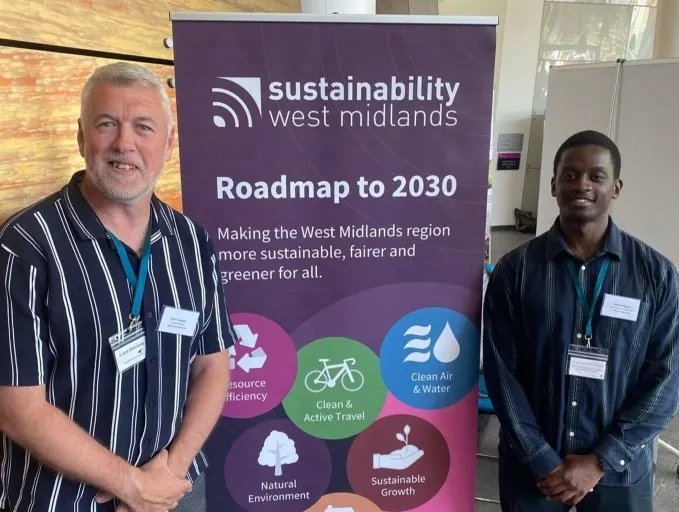
Photo: Peter Douglas, general manager, commercial at Metal Assemblies and Ronnie Akumu, KTP associate