
Board-level executives believe that increased complexity is making it harder to make the right decisions at the right time and adding significant risk, according to research.
Research conducted by management consultancy, Vendigital, with 201 C-suite executives at UK-based companies, has revealed that 84% of respondents believe that it has become more challenging to make the right decisions over the past year, due to the need to weigh up complex considerations. Only 1% of respondents said it had become less challenging.
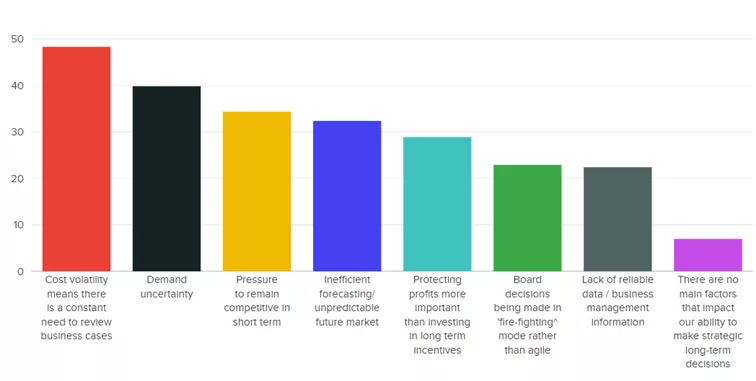
The main reason that respondents gave for this increased complexity was ‘cost volatility’, which is affecting commodities such as power supplies and fuel, as well as raw materials and other goods. The on-going climate of geopolitical and economic uncertainty, largely due to the war in Ukraine and high inflation, means cost unpredictability is set to remain.
Julie Neal, Director at management consultancy, Vendigital, said: “Cost volatility is a de-stabilising factor for many C-suite executives across industry sectors; impacting their ability to make the right decisions at the right time. Prior to the pandemic, costs were much more predictable, and this made strategy setting and implementation a less risky process.
“As well as cost volatility, the respondents identified several other factors that are making boardroom decision-making more complex and challenging including global supply shortages, depleted cash reserves and shifting consumer demands.
“This multiplicity of factors, combined with the prevailing uncertainty, is creating a web of complexity for Boardroom decision makers.”
Top of the list of decisions that C-suite executives find the most challenging in the current climate are ‘pricing decisions’ – i.e. knowing whether to absorb cost increases or pass them on to customers, or deciding to reduce prices to drive market share. Other decisions ranked as challenging include cost-cutting decisions; operational decisions; ESG performance-related decisions; people decisions, procurement decisions and capital investment decisions.
Almost half - 49% - of C-suite executives felt their decisions had been skewed in favour of short-term considerations over the past year, suggesting that they have been less focused on long-term objectives. One in five (22%) respondents said that they had been stuck in ‘fire-fighting mode’ over the past year.
“While some C-suite executives understandably feel that cost volatility and demand uncertainty have given them little choice but to focus on short-term considerations over the past year, it is possible that long-term decisions have been sidelined due to a lack of visibility. In some cases, this could be resolved by adopting more reliable industry-specific data-based systems,” commented Julie Neal.
The research revealed that data trust is a significant issue for C-suite executives. Only one in five (21%) said they have total trust in the business information they are using to inform their strategic decisions. The remaining 79% of respondents said they trust their data only some of the time.
“Without complete data trust, Boardroom executives are flying blind. In today’s complex, highly competitive and ever-changing world, businesses with access to accurate and reliable data-based models will be best placed to mitigate risks and exploit opportunities,” concluded Julie Neal.
For more information about the research, commissioned by Vendigital.