
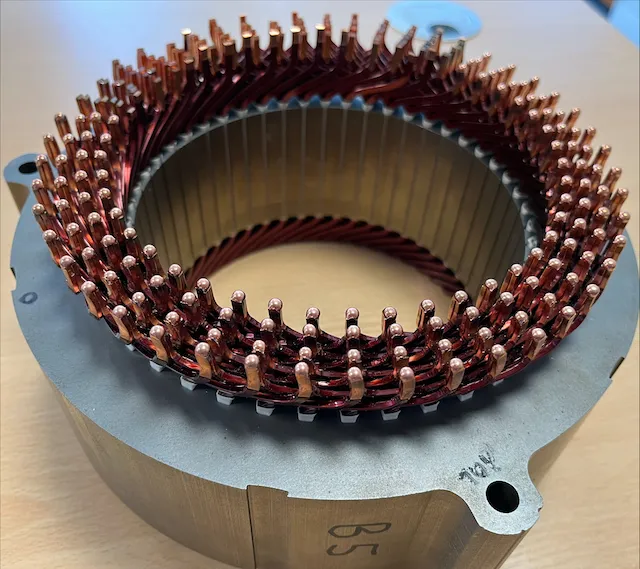
An innovative collaboration between Cambridge Vacuum Engineering (CVE) and Ford could make a significant impact on electric motor stator manufacturing.
Cambridge Vacuum Engineering (CVE) and Ford have successfully concluded a £430,000 Innovate UK-funded initiative, EB-eDrive project, marking a significant milestone in the production of electric motor stators for the rapidly expanding electric vehicle (EV) market.
This collaborative effort, part of Innovate UK’s Driving the Electric Revolution Challenge, set out to demonstrate that advanced electron beam welding technology can dramatically improve both the quality and consistency of stator manufacturing processes.
As the UK presses ahead with its net-zero carbon ambitions, the findings from this project offer a promising pathway to bolstering domestic EV production. Demand for electric vehicles is rising sharply, but persistent barriers such as high costs and complex manufacturing requirements continue to hinder widespread adoption. The stator, a critical component in electric motors, demands precision engineering to maximise efficiency, performance and durability—making advancements in its manufacture particularly consequential.
Electron beam welding, as showcased by CVE’s proprietary technology, presents several compelling advantages over traditional methods. Unlike infrared lasers, which often struggle with reflectivity issues when joining copper hairpins, the electron beam method eliminates the need for pre-weld preparation such as trimming. This not only streamlines the process but also enhances repeatability and reliability. Tests conducted during the project revealed that welds produced via this technique consistently exhibited tensile strengths averaging six times the minimum industry standard. Furthermore, the vacuum environment intrinsic to electron beam welding facilitates easy outgassing, resulting in completely pore-free joins—especially critical for oxygen-free copper used in stator construction.
Bob Nicolson, CEO of CVE, emphasised the wider implications of the technology: “As automotive brands aim to deliver higher performance and greater range at lower costs, electron beam welding emerges as a game-changer. We’re witnessing similar transformations in other sectors, such as energy, where electron beam welding is being harnessed to produce wind turbine monopiles and nuclear pressure vessels. We are immensely grateful for Innovate UK’s support, as projects like EB-eDrive pave the way for commercialising advanced manufacturing methods and help keep the UK at the forefront of EV innovation.”
Ford’s Director of EU Powertrain Manufacturing Engineering, Lee Turner, echoed these sentiments, highlighting Ford’s commitment to pushing the boundaries of stator hairpin weld quality and efficiency. “Our team’s work on laser parameter set-up and repair processes has set industry benchmarks, but electron beam welding offers a clear opportunity for further gains. Partnering with CVE, with their unrivalled expertise, is invaluable as we explore routes toward full-scale industrial adoption of this technology,” Turner said.
As the UK looks towards a greener future, advancements like electron beam welding could prove pivotal in making electric vehicles more accessible, efficient and sustainable for consumers nationwide.