
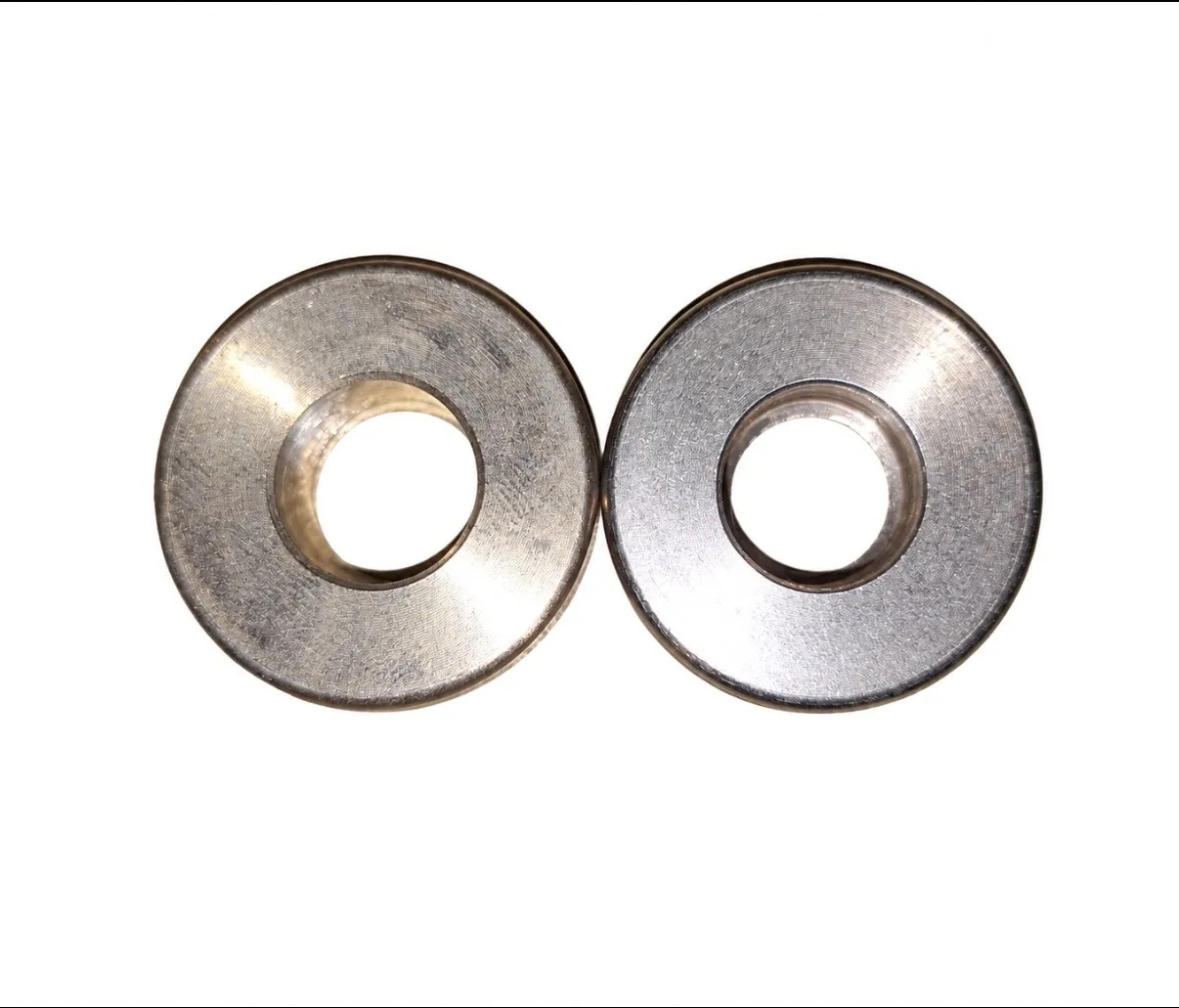
A modest investment in automated surface finishing is delivering significant benefits for Computech Turning. It has improved productivity, produced more consistent finishes and enhanced customers’ perception of quality.
Just as importantly, it’s releasing skilled production staff from repetitive hand-finishing work so that their time can be directed to more productive, value-added activity.
The Ashton-under-Lyne company, which manufactures specialist threaded parts and CNC-machined components for customers across demanding engineering sectors, has introduced Rösler finishing technology to replace time-consuming manual deburring on selected components.
Central to the operation is an FKS 02.1E high-energy disc machine, used to deburr and improve the surface finish of precision-machined parts. Rösler’s high-energy disc technology uses centrifugal action to create significantly greater processing intensity than conventional vibratory finishing and can be applied to deburring, grinding, edge rounding and polishing.
Previously, components requiring attention could involve operators manually removing burrs with files. While effective, the process consumed skilled manufacturing time and made larger batches particularly labour-intensive. Automated finishing has allowed multiple components to be processed together while operators concentrate on higher-value production activities. For a small engineering team, that matters disproportionately. Instead of working through components one by one with a file, skilled people can spend more time on machining and other value-added production tasks.
Managing Director Dave Wray says, “We originally saw automated deburring primarily as a way of saving time, but the benefit goes further than that. We are producing components with clean edges and a much more consistent, professional finish. For a precision engineering company, that presentation matters because it is part of the quality the customer sees.”
The business case is therefore built around more than speed alone. Computech reports reduced scrap and more consistent results, while batch processing removes much of the operator-to-operator variation inherent in manual deburring. Because the company handles a varied mix of work, it does not reduce ROI to one simple payback figure, instead, the return is visible in recovered labour time, fewer finishing inconsistencies and productive capacity released elsewhere in the business.
The FKS investment followed practical trials with Computech’s own components at Rösler. Parts were processed for different cycle times, allowing the team to establish a result that was not merely acceptable, but better than could routinely be achieved manually.
Michael Nield, Managing Director of Florsheim Consultants and a long-standing adviser to Computech, said the ability to prove the process and access expertise afterwards was decisive.
“Probably 80% of the reason we went to Rösler was the support,” Nield says. “You can pick up the phone, explain the component, and ask what media or compound you should be using. That expertise is incredibly valuable.”
Nield concluded: “It has paid off, definitely. For a smaller engineering company, investments have to make practical sense. We save time, improve the finish, and know that if we need advice, the expertise is there.”