
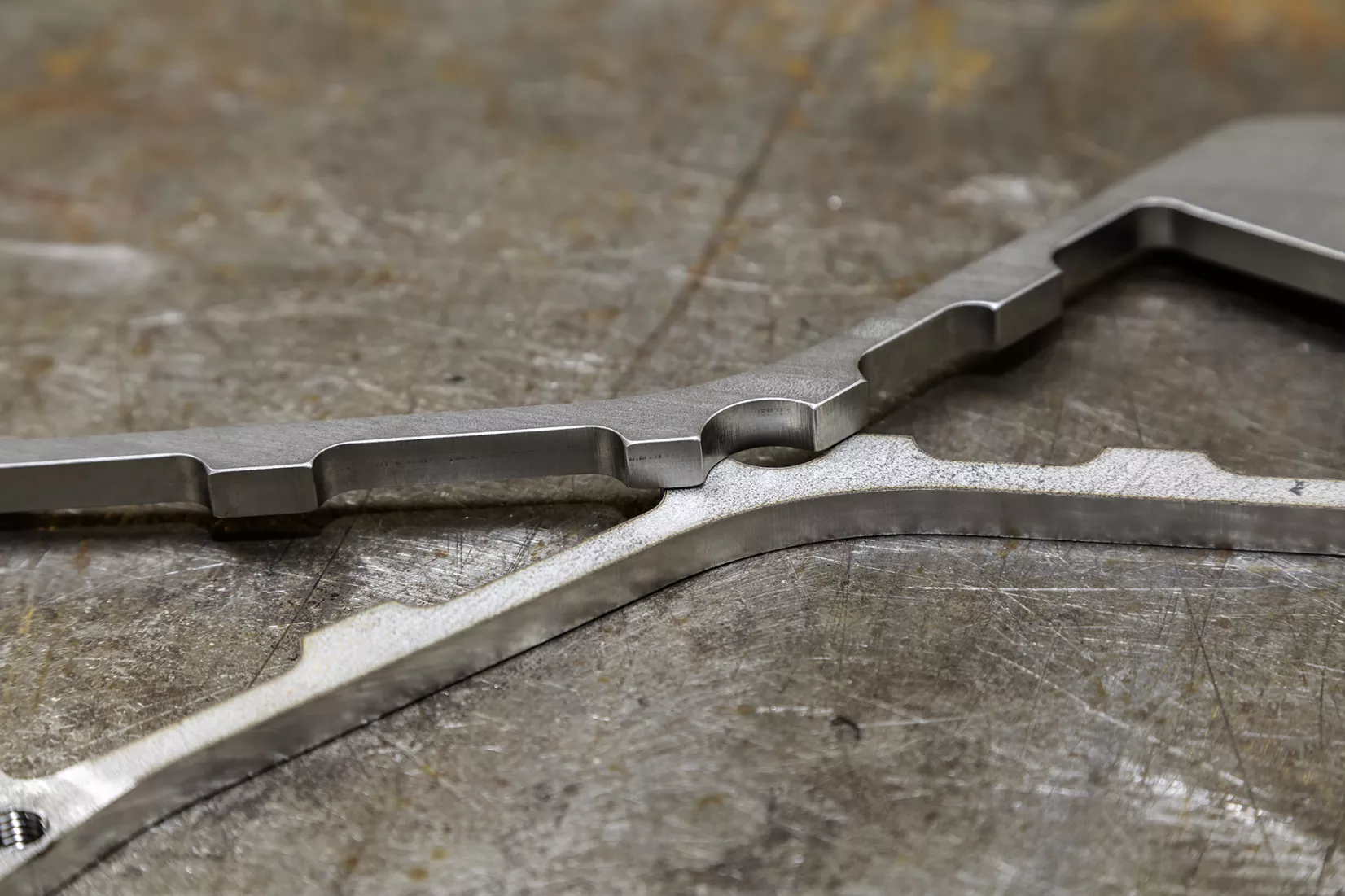
A new finishing machine at Dutton Engineering improves part quality and speeds throughput on punched, lasered, and waterjet cut parts.
Dutton Engineering based in Sandy, Bedfordshire is a specialist sheet metal sub-contractor. The focus of its 40 years has been stainless steel sheet, serving customers in the food processing, medical and architectural sectors. For these customers attention to detail, premium finish and quality products are essential and the company prides itself on the quality of its work; most of which is visible in the finished product.
Managing Director Andrew Read says: “We pride ourselves on the quality and on-time delivery promises that we keep and, with our production focused mainly around high-value stainless steel. The parts we produce must reflect the materials inherent value in both visual and handling terms. For this reason, we place foremost focus on deburring and graining,”
To support its customers Dutton Engineering has a comprehensive capacity list including punching, laser, waterjet, bending and forming, as well as milling and turning capabilities.
When a new contract demanded guaranteed consistent burr free parts (which contained multiple slots) the company decided to purchase a Timesavers 42-1350-WRb machine from Ellesco This has a wide abrasive belt head and an eight brush rotary head that combines deburr and graining operations in a single pass. A vacuum table allows the machine to process parts ranging from 1350 mm wide sheet up to 4500 mm long, down to parts measuring just 50 mm by 50 mm and up to 150 mm thick. In addition to deburring the machine also creates consistent edge radii.
Mr Read says: “The advantage we are getting with the Timesavers machine is the ability to generate a consistent edge on components, which is something we now use as part of our sales proposition to customers. When compared with deburring manually not only have we gained in terms of quality, but also time, with processing times being reduced typically by 75 per cent for deburring parts. This is a major bonus as removing any burrs is important for us, especially with the work we do for customers in the food processing sector, where there is the need to eliminate any risk of personal injury or contamination.”
The size of the machine table means that multiple parts can be processes simultaneously, and only requires an operator to feed / remove parts. This leaves Dutton Engineering’s highly skilled polishers, who used to be involved in manual deburring, free to do the work they are best suited to.
“With the addition of the rotary brushes for deburring the new machine provides much greater flexibility in terms of production, with key benefits being the ability to process punched and lasered parts as well as those that have been cut using our waterjet machine, which may not have burrs, but do have sharp edges to them that need to be rounded off, whether on external or internal edges (such as holes and slots). Due to the importance of the finished product in visual terms we can also deburr sheet that still has its protective plastic coating applied,” concludes Mr Read.