
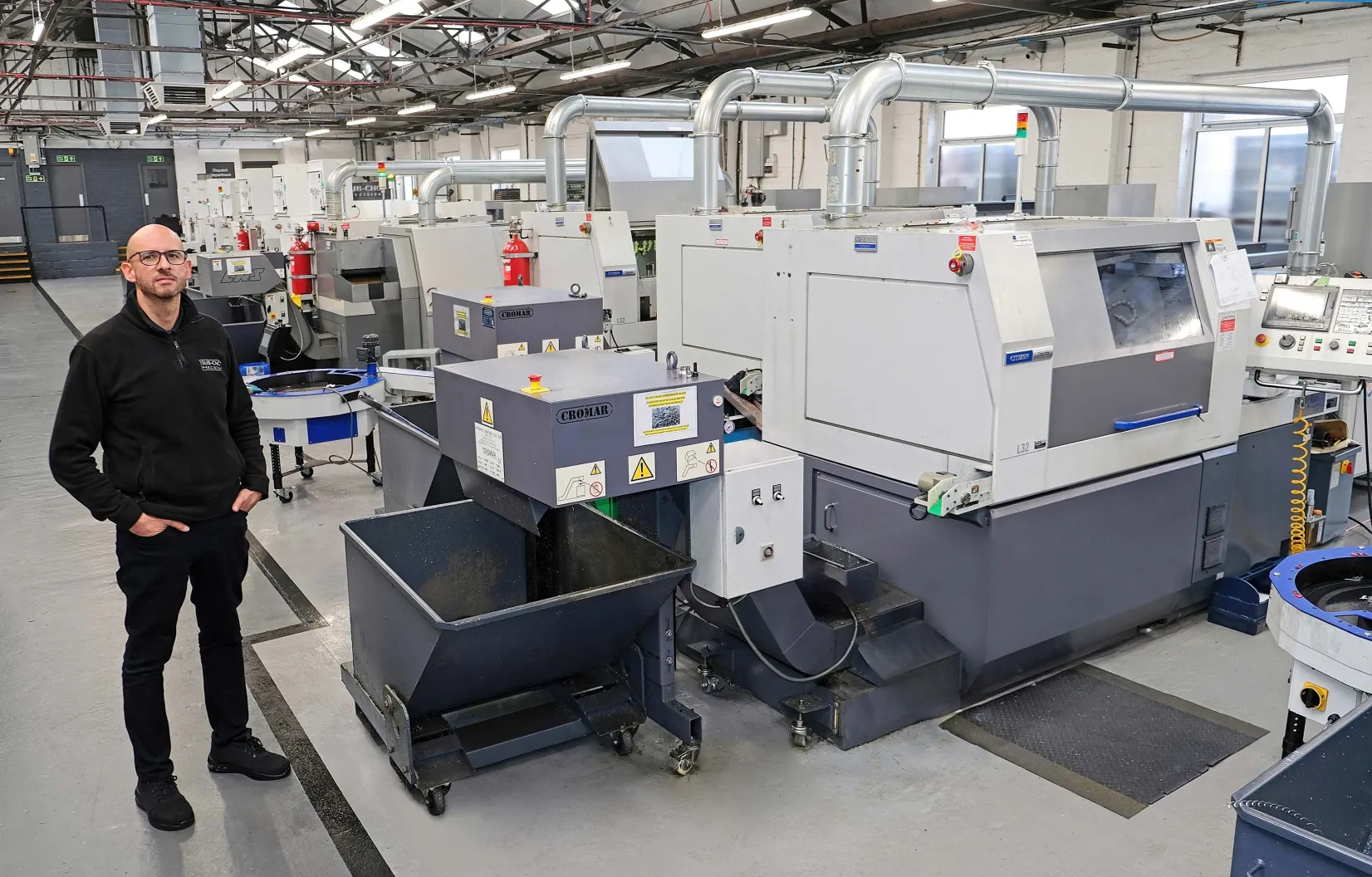
Luton-based subcontractor Sub-CNC Precision has taken delivery of two additional Citizen lathes, bringing the total number on its shop floor to 21.
Known for its commitment to quality and innovation, this ISO 9001:2015-accredited and JOSCAR-registered company has consistently invested in advanced CNC technology to meet the exacting demands of a wide array of industries.
As of November 2025, the company has acquired 25 Citizen lathes over the years, strategically part-exchanging some to maintain a fleet of 21 of the latest machines.
This recent expansion underscores its ongoing dedication to delivering high-quality, precision-engineered components while remaining competitive in an increasingly global marketplace.
Two-thirds Sub-CNC’s machines are Cincom sliding-head models, which are adept at producing intricate parts ranging from as 0.5 mm to 38 mm in diameter. The remaining machines are Miyano fixed-head turning centres, which offer robust capability for larger diameter components.
These machines are not only central to the company’s production strategy but also operate with remarkable efficiency, with many running 'lights-out' from 18:00 to 07:00. This approach enables the business to maximise productivity and meet tight deadlines across multiple sectors, including aerospace, defence, automotive, motorsport, telecommunications, energy and renewables, hydraulics, medical, and instrumentation.
In total, there are now 27 CNC machine tools on the shop floor. Alongside the Citizen lathes, the facility houses another fixed-head turning centre, three vertical machining centres equipped with a 4th axis, a CNC cylindrical grinding machine, and a state-of-the-art 3D printer. This extensive suite of equipment gives the company the capability to serve both high-volume and specialist low-volume requirements.
A key element of the subcontractor’s success has been the adoption of Citizen’s proprietary LFV (low frequency vibration) chip-breaking technology. First introduced in 2017, this innovation has transformed the landscape of unattended machining.
Joint-owner Yian Stavrou explained: “In 2017, we installed one of the first LFV machines in the country, a 20 mm bar capacity L20-VIII which arrived in the April, followed at the end of that year by a 12 mm capacity L12-VII.
“It was immediately clear that their ability to break what would normally be stringy swarf, which would necessitate stopping the machines to clear it away manually, into short chips meant we could leave them unattended to produce components, even from difficult-to-machine materials, knowing that we would arrive in the morning to a bin full of perfect parts. It is the only way to remain competitive in the face of competition from low-wage countries.”
The transformative impact of LFV was evident from the outset. The two initial LFV-equipped lathes were immediately tasked with producing turn-milled parts from copper and phosphor bronze, both materials notorious for generating long, continuous coils of swarf. The effectiveness of LFV in breaking these into manageable chips allowed for uninterrupted, lights-out production. The technology has since proved equally adept at handling challenging materials such as Monel, Inconel, titanium alloys, and other exotics, including those required for submarine component manufacture. Buoyed by these successes, Yian and co-owner George Dingley have ensured that every new Cincom lathe acquired since 2017 has been equipped with LFV. Currently, more than half of the sliding-head lathes on site benefit from this function.
LFV is not only valuable for difficult materials. When machining copper, for example, the software is deployed for the majority of the cycle to prevent the formation of hazardous ribbons of swarf. Its utility extends to more malleable materials such as stainless steel and aluminium, as well as engineering plastics like nylon, PEEK, acetal, POM, PTFE, and ABS. The technology’s true advantage lies in its programmability: operators can use G-codes to switch LFV on and off during a machining cycle, and select different modes to tailor chip size to the application. This flexibility ensures that productivity is maximised, with LFV only engaged where enhanced chip-breaking is required, thereby avoiding unnecessary reductions in output.
George points to further features of the Cincom lathes that have contributed to the company’s competitive edge. The machines boast 140-bar high-pressure coolant delivery to the cutting zone, a capability that greatly aids chip breaking, especially during part-off operations. Another notable innovation is the removable guide bush, which can be swapped in and out in just half an hour. This design enables the economical use of lower quality, unground bar that might otherwise seize in the guide bush, and reduces bar remnant length, resulting in material savings. The set-up is particularly well-suited for parts whose length is less than 2.5 times their diameter, as radial flexure caused by the cutting tool infeed remains minimal—even at the unsupported end of these relatively short components.
The Miyano fixed-head lathes, meanwhile, have played a significant role in broadening the company’s capabilities. These machines process bar from 8 mm up to 65 mm in diameter, as well as billet up to 200 mm. The first Miyano BNA-42MSY turning centres were installed in 2012, primarily to support the manufacture of complex turn-milled components for the oil and gas sector.
Most recently, a Miyano BNE-51MSY was added in July 2025, arriving alongside a new Cincom L20-XLFV, to boost fixed-head turning capacity. In total, three new Citizen machines—including the latest Miyano and a third-generation A20-VII—have joined the shop floor in the first seven months of the year.
This ongoing investment in advanced CNC technology reflects the subcontractor’s commitment to quality, efficiency, and innovation. By embracing state-of-the-art solutions such as LFV and maintaining a diverse array of machining centres, the company is well-equipped to tackle the challenges of modern manufacturing. Its ability to deliver precision-engineered components across a spectrum of industries not only reinforces its position as a leading player in the subcontracting field, but also demonstrates the value of continual technological advancement in ensuring competitiveness and customer satisfaction in today’s fast-paced industrial landscape.