
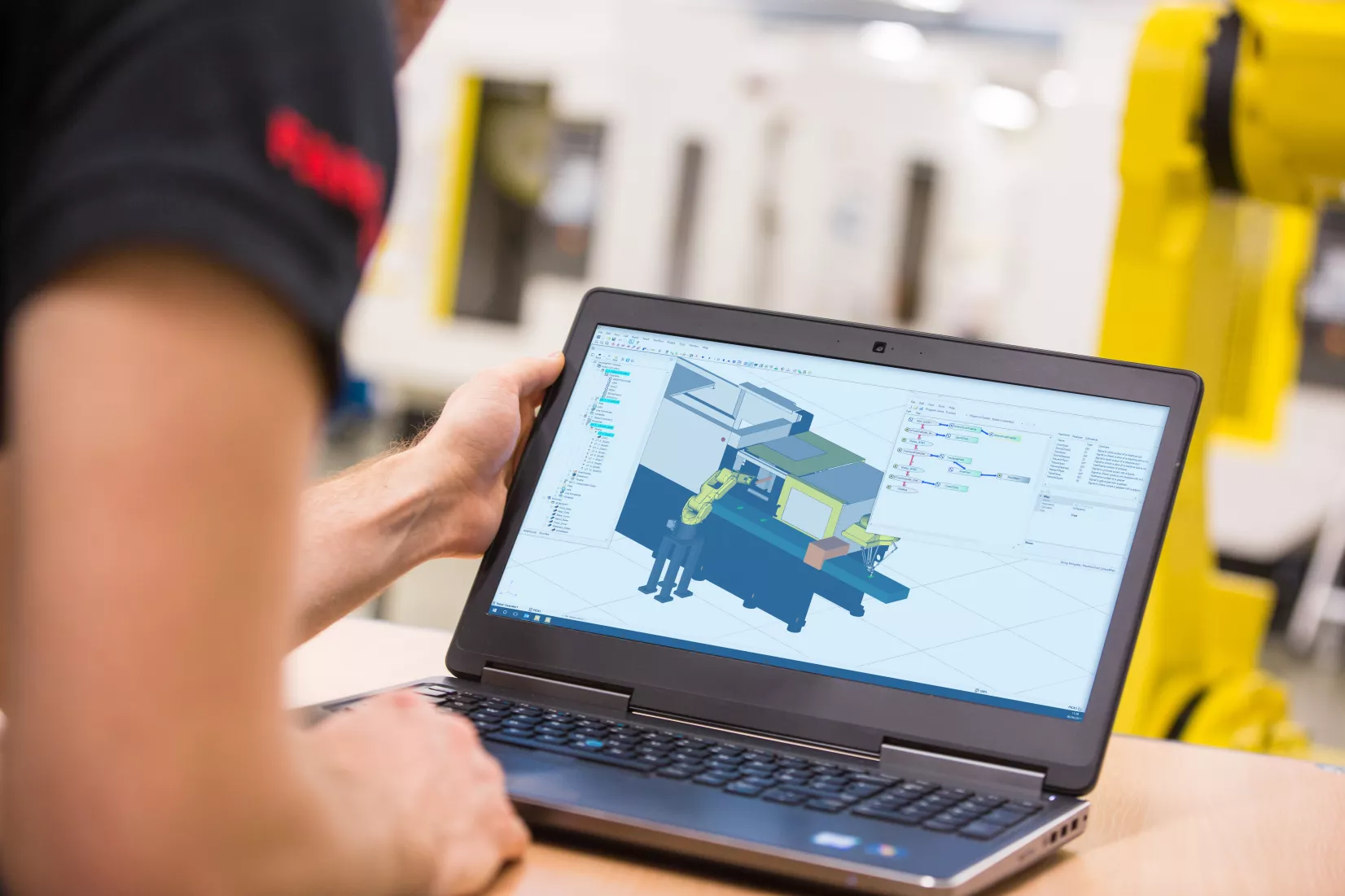
A six-axis robot is helping solve an insert handling problem on a white goods project at Mitre Plastics
Located in north-east England and boasting a 50-year history, in 2019, Mitre Plastics was invited to quote for producing a high-volume part with a brass insert for a white goods manufacturer, requiring a repeatable, high-speed insert loading solution. To get an idea of how the part could be produced on its existing FANUC ROBOSHOT α-S220iB injection moulding machine, Mitre Plastics asked an unnamed automation supplier to scope out a conceptual solution.
“They suggested using a collaborative robot in conjunction with our existing injection moulding machine and three-axis robot to handle insert loading,” said General Manager Michael Breckon.
“When we took the proposal to FANUC to discuss providing additional hardware and integration work for the solution, it raised questions over how it would work in practice,”
The review highlighted a number of limitations with the proposed solution, with FANUC’s engineers concluding that this application was not wholly suited to a cobot.
As FANUC’s senior integration engineer James Pointer explained: “Firstly, collaborative robots are intended to work unguarded, but in this case, a guard was required, adding cost. Secondly, the proposal was to mount the cobot on the moulding machine at head height, which would not comply with health & safety guidelines. And thirdly, cobots are inherently slow, whereas the key with injection moulding is to minimise mould open time for maximum productivity.”
Instead of a cobot, FANUC proposed a simpler, faster, more efficient and more flexible solution, comprising a six-axis robot cell. To assist in this alternative approach, it engaged Hi-Tech, its long-term strategic partner for injection moulding handling and integration. The two companies worked seamlessly to devise a solution that involved replacing the existing three-axis robot with a side-entry six-axis robot. This would take four inserts from a bowl feeder, enter the moulding machine through the side door, place the inserts into the mould in the correct orientation, demould the finished component and conduct post-mould checks – all within the specified cycle time.
“With the aim of reducing cost and complexity to the existing system, we designed a self-contained industrial automation cell,” said James.
Flexibility was also an important consideration in this project as, although the contract was large, other work still needed to be kept on the moulding machine.
“As the name suggests, with a three-axis robot you have three axes of movement: up and down, left and right, forwards and backwards, so when the gripper comes down you can’t change the angle. A six-axis, in comparison, gives you full rotation and therefore free movement. For the manufacture of plastic parts with over moulded inserts, this freedom of movement is invaluable, as precision and accuracy are key to successful production,” added James.
For Mitre Plastics there is a further advantage associated with using a six-axis robot on this application, relating to gate removal. A secondary operation performed by the three-axis robot had been the removal of gates (plastic left on the mould) using pneumatic cutting tools; however, this required several cutters set at different angles.
The six-axis has given greater flexibility when removing gates from products. Instead of having to use several different cutters set at different angles the part can now be offered up to just one cutter.