
In the face of rising electricity bills, higher raw material costs, and increased company taxes, C&M Precision is using advanced technology maximise productivity and stay competitive.
The 13-person subcontract turn-milling firm, led by owner and managing director John Cable, has invested heavily in Japanese-built lathes from Citizen Machinery UK, leveraging their proprietary LFV (Low Frequency Vibration) chip-breaking software to maximize productivity and minimize waste.
LFV technology, integrated into both main and sub spindles, synchronizes servo axis infeed with spindle rotation, creating microsecond periods of air cutting. This process breaks up stringy swarf from malleable materials into manageable chips, a significant improvement over traditional pecking macros and dwells. The software offers three modes: Mode 1 for turning and grooving, Mode 2 for high-speed operations like fine machining or deep drilling, and Mode 3 for threading.
Mr Cable said: "We were an early adopter of this technology, buying our first L20-VIIILFV Cincom sliding-head lathe in 2017, the first year the function was available on Citizen turn-mill centres in Europe. I would never buy another lathe without LFV. We only source machines from Citizen and nearly half of our 13 lathes on the shop floor have the chip-breaking functionality, five Cincoms and a fixed-head Miyano."
In the past two years, C&M has acquired four new lathes, investing nearly £750,000 to modernize its Maldon, Essex facility. LFV-enabled lathes are particularly valuable for processing highly malleable metals such as OFHC (oxygen-free high conductivity) copper and HE9 aluminium, both of which present significant chip control challenges. The technology is also essential for machining plastics, which tend to form tangled swarf. One contract requires machining 3,600 metres of acetal bar annually, and another for a long medical device would be unmanageable without LFV.
"LFV makes mincemeat of all these difficult jobs – it really works, even on nickel alloys, and is useful for both roughing and finishing. Naturally, the brief periods when the tool is lifted clear of the surface of the bar reduces material removal rate, but only slightly. It is more than offset by preventing long swarf from damaging a component or tool, by avoiding having to stop the machine to clear tangled swarf, and by having all good parts in the container at the end of a long period of unattended running, including overnight," Mr Cable explained.
LFV is programmable, with G-codes used to activate or deactivate it during a cycle. It is not used for materials like brass or free-cutting aluminium or steel, but when required, its intensity is adjustable. Citizen’s Alkart Wizard programming interface recommends LFV pulse rates based on bar diameter and material, but C&M staff often reduce the pulse rate by 50–65% to optimize chip length and productivity, while also reducing tool stress and noise.
The latest addition to C&M’s fleet, delivered in June 2025, is a Cincom L32-XIILFV sliding-head lathe with a 32 mm bar capacity, B-axis live tool carrier, and long parts collection unit. Its precision is demonstrated by its ability to machine 12 equispaced slots in a 25 mm OFHC copper anode to a width tolerance of 14 microns. The B-axis is also essential for milling angled flats on titanium ball joints, eliminating the need for secondary operations. Mr Cable consistently opts for the most capable machine variants, including those that can handle oversize bar stock up to 38 mm.
A 12 mm capacity Cincom L12-XLFV, acquired a year earlier, has transformed small-part production. For example, it machines connector contacts from beryllium-copper bar to tight tolerances, with features less than a millimetre in diameter.
C&M’s fixed-head, twin-turret, twin-spindle Miyano ANX-42SYY, installed in December 2024, joined two larger BNE-65MYY models. The ANX, a 10-axis CNC lathe, was Citizen’s first fixed-head model with LFV and offers advanced capabilities such as 3-axis simultaneous cycles and superimposed machining with three tools.
Production manager Leon Rawlinson introduced single-point broaching for hex and Torx features, replacing wobble broaching. This method, enabled by the Miyanos’ power and Y-axis capability, improves surface finish and reduces machine stress, helping C&M win new business.
Modern technology, including removable guide bushes on Cincom models to reduce bar costs and waste, helps offset rising operational expenses. The ability to produce prismatic parts on turn-mill centres, often at lower cost than machining centres, provides additional business opportunities.
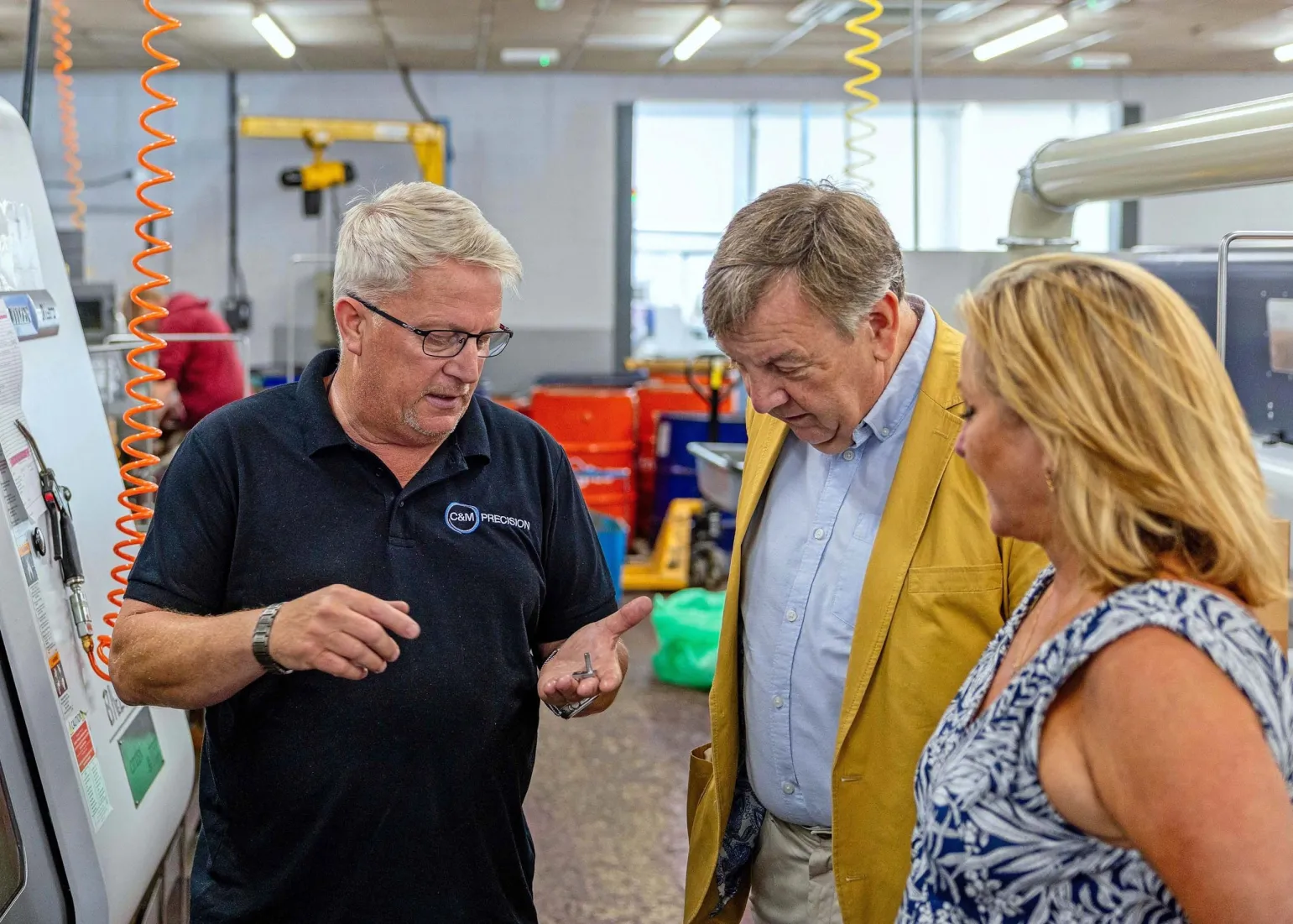
Despite these advancements, Mr Cable remains concerned about the lack of government support for manufacturing. He has actively campaigned for better representation, meeting with Rt Hon Sir John Whittingdale OBE MP in July 2025 to discuss challenges such as escalating energy costs. The issue was subsequently raised in Parliament, highlighting the broader need for policy attention to the SME manufacturing sector.
C&M’s efforts underscore how targeted engagement with policymakers can drive broader conversations and encourage government action on systemic issues affecting UK manufacturing. Mr Cable awaits further feedback.
Phtot: John Cable (left) speaking with Rt Hon Sir John Whittingdale OBE, Conservative MP for the Maldon constituency, when he visited C&M Precision in July 2025. Visiting on the same day was Andrea Wilson, a director of Hone-All Precision, who is equally vocal about the need for a Government tsar to look after the interests of SMEs.