
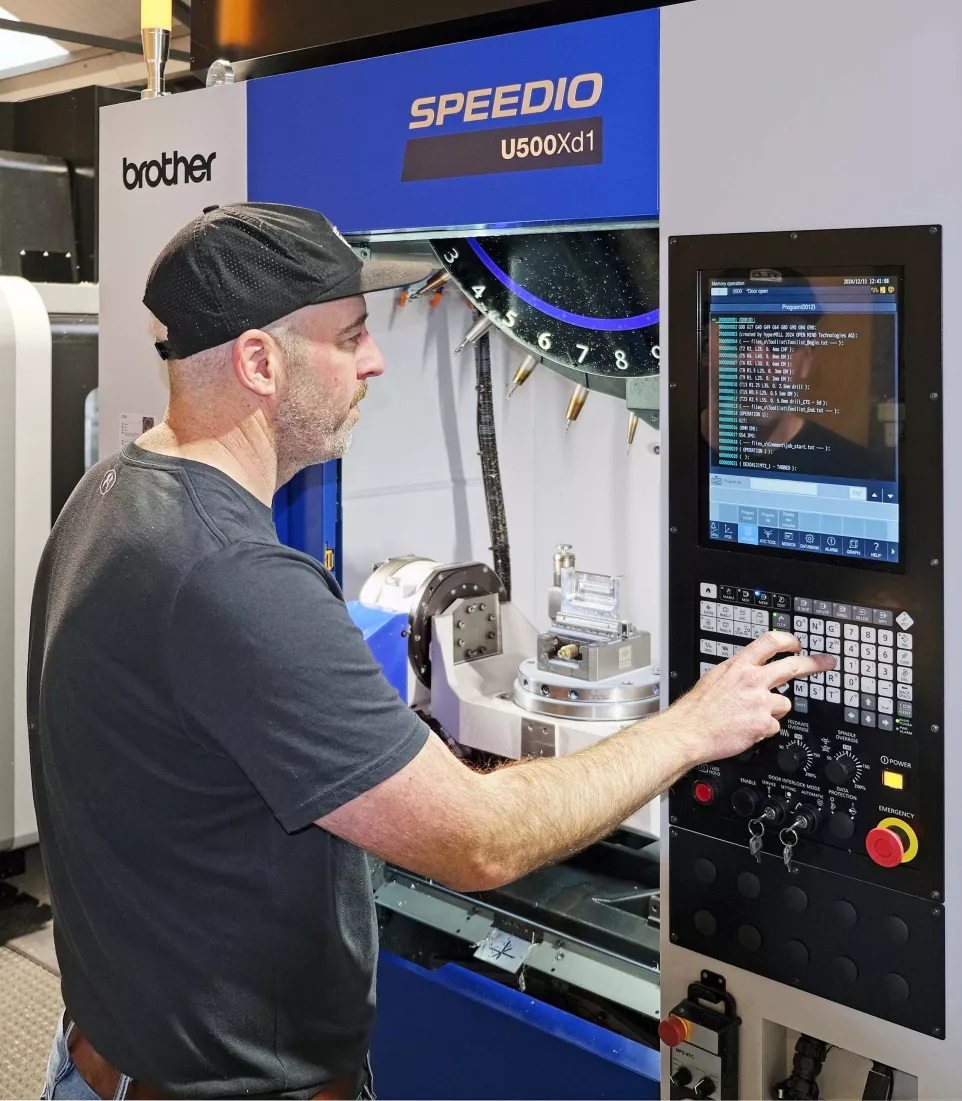
A new Brother Speedio 5-axis machining centre at contract manufacturer Atomic Precision meant it could accept an order it couldn’t otherwise have fulfilled.
Michael Phillips, joint owner with partner Wayne Robins of Atomic Precision, describes the Japanese-built Brother Speedio U500Xd1 as "a Swiss army knife of 5-axis machining centres". His comment is due to the 30-taper machine's high quality, versatile functionality, compactness, and ability to complete an extensive range of jobs quickly and efficiently.
In November 2024, Atomic Precision received an unusually large order from a new customer for 400-off aluminium brackets requiring a 3+2 machining strategy, using the rotary axes to position the part. The subcontractor could not have accepted the contract if it had been unable to use the elevated speed of the Brother machine. A 5-axis, 40-taper VMC would have been too slow to meet the three-week lead-time, so the subcontractor would have had to turn down the work. If more jobs involving quantities of several hundred start coming in, automating the Brother and indeed other VMCs on-site will go ahead imminently.
Founded in East Hendred, Oxfordshire, in 2020 by the two time-served mechanical engineering apprentices, who both previously worked in the machine shop at nearby Rutherford Appleton Laboratory's space development facility, Atomic Precision specialises unsurprisingly in manufacturing components and assemblies for the space and scientific research sectors.
The company had been growing at 50% year-on-year and the partners realised that this rate of growth could only be sustained with more efficient machine tools and automation for substantial periods of unmanned operation.
As a first step to raising productivity, the high-speed Brother U500Xd1 was installed and commissioned by Whitehouse Machine Tools in September 2024.
Mr Phillips said: "The area taken up on our shop floor by the U500Xd1 is half of the space that one of our 40-taper 5-axis machines occupies, yet the 30-taper VMC actually produces larger parts.
"Not only that, but the Speedio finishes an identical component in two-thirds of the time, as the non-cutting elements of cycles are incredibly short, so tools are in-cut for typically 90% of the time during a cycle.
"The linear axes accelerate at 2.2 g up to 56 m/min and chip-to-chip time is 1.3 seconds. Rotary positioning by the trunnion and table are similarly fast and parts come off complete, resulting in really quick floor-to-floor times."
As well as producing parts up to the maximum working envelope, the Speedio also machines very small components requiring complex features cut with a 0.2 mm diameter end mill, hence the decision to opt for the highest speed spindle Brother offers. Extensive use is made of towers for fixturing multiple smaller parts to extend walk-away time from the machine if individual cycle times are short. Batch size is normally up to 10-off, although often single prototypes are machined.
A large variety of materials is processed in the factory, including aluminium, stainless steel, brass, copper, tungsten and tantalum. Mr Phillips says that it is possible to hold ± 10 microns dimensional tolerance "comfortably" on the Speedio, even without climate control in the factory.