
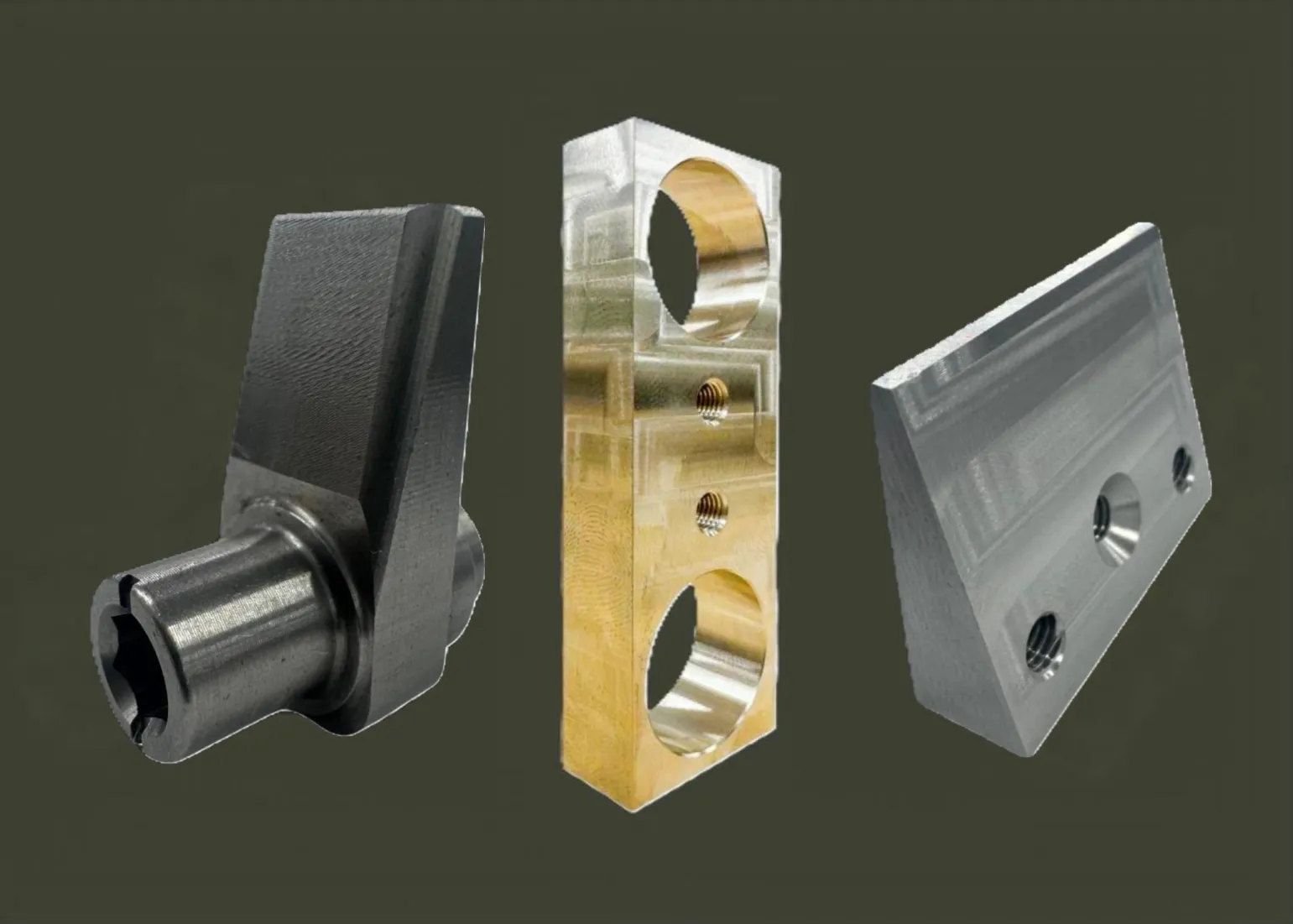
Maldon-based subcontractor C & M Precision takes a ‘one-hit CNC’ approach to ensure that customers get high levels of quality at competitive prices.
That means that all the components it manufactures on its Citizen and Miyano fixed and sliding head turning centres are produced from bar in one pass.
The advanced capabilities of these multi-axis turn-milling systems has also allowed it to extend its offering to produce milled prismatic components direct from bar too.
As managing director John Cable explains, the spindle acts as a positioning axis while driven tooling completes all the prismatic machining operations.
He described the machining route for one of the jobs C & M is currently producing: “The bar is held stationary in the spindle, faced and parted off. We machine round the outside, drill and tap holes, turn it over, drill the back side and deburr it.
“Normally that would be a two-operation job as you still have one side to machine. However you look at it, if you are producing it on a machining centre you have to flip it over at some point. We have the part machined on five sides still attached to the bar and then we can pick it up with the sub-spindle, part it off, finish off the back and while we are starting the next component on the main spindle.
“We can leave it running unmanned overnight producing complete parts, whereas if you were making them on a machining centre you would have to flip them over to complete the second op the next day.”
John says that complex features, such as drilling and tapping holes perpendicular to angled faces can be easily incorporated without the need for second operations. On some components, what might have been a three-operation job on a milling machine can be done in one.
Size is obviously a restriction, C & M’s biggest machine has a maximum bar capacity of 65mm, but where prismatic components are suitable the arguments for producing them on a turn-mill centre are compelling.
John said: “The advantage to the customer is a much more competitive price because there's no flipping of the part. We are not stopping the machine, opening the doors, flipping them over, starting up again. We can run the machine unmanned because it just keeps on making them. You just absolutely obliterate prices. Geometrically, they're very good too because, again, you aren’t flipping the part.”
Another innovative machining approach is to extend the maximum length of component that a machine can produce by re-gripping the part one or more times.
The Citizen machines feature a maximum Z1 stroke between 250 and 330mm, depending on the model. For longer parts the process involves re-chucking: using the sub-spindle to release and re-grip the workpiece, allowing continuous machining from a single bar.
To facilitate this the two newest sliding head turning machines, an L12X and an L32X11, are fitted with long part extraction units that can safely remove these finished components without manual intervention.
One part produced using this technique is 400mm long, with a right-hand thread on one end, a left-hand thread the other end, as well as several grooves and drilled holes.
“You can't machine it in one chucking, “said John. “So you have to grab it with the sub-spindle, let go with the main, go and grab some more, and then carry on machining. You can actually keep going and make a part out of a complete bar if you want, as long as you can get it out the other end.”
Investing in equipment and people
Over the past year C & M has continued to invest in new equipment and has also taken on more staff.
The latest machine, currently on order, is a Citizen L32 XII sliding head machine with LFV on four axis.
Citizen’s LFV synchronises high-frequency vibration in the direction of the cutting feed with spindle rotation to create intermittent air-cutting to break long swarf effectively. 4-Axis LFV is a new development that allows the function to be programmed to start and stop in four separate axes at the same time – the X and Z movements of both the main and sub spindles. Citizen says that 4-axis LFV is a major step forward, as it enhances flexibility, reduces cycle times and eliminates operational bottlenecks.
“We are in the process of changing all our machines over to LFV versions,” said John. “All of our most recent machines have it. I won’t buy a machine without it.”
With the ongoing skills shortage, C & M takes matters into its own hands by developing its staff in-house – passing on the knowledge of the management team and senior staff.
“Training is a really big, important thing here now, getting the skills level up right across the whole factory,” said john. “We have put a lot of man hours into it, and it has really paid off. We have taken new starters with fairly low levels of CNC skills, and they are now working on our most complex multi-axis machines.”
C & M is also upgrading its metrology capabilities with a new automated shop floor optical measure system. This camera-based system quickly establishes key measurements without the need for fixturing and is very operator friendly.
“It's going to be really, really helpful. It will simplify and speed up setting and will be very good for quick First-Off Article Inspection Reports (FAIRS),” said John.
“We constantly invest in faster and better machines to compensate for increased costs so that we can keep down prices for our customers. But we are not just putting money into machines, we are putting money into measuring the components too to improve the service we give our customers.”