
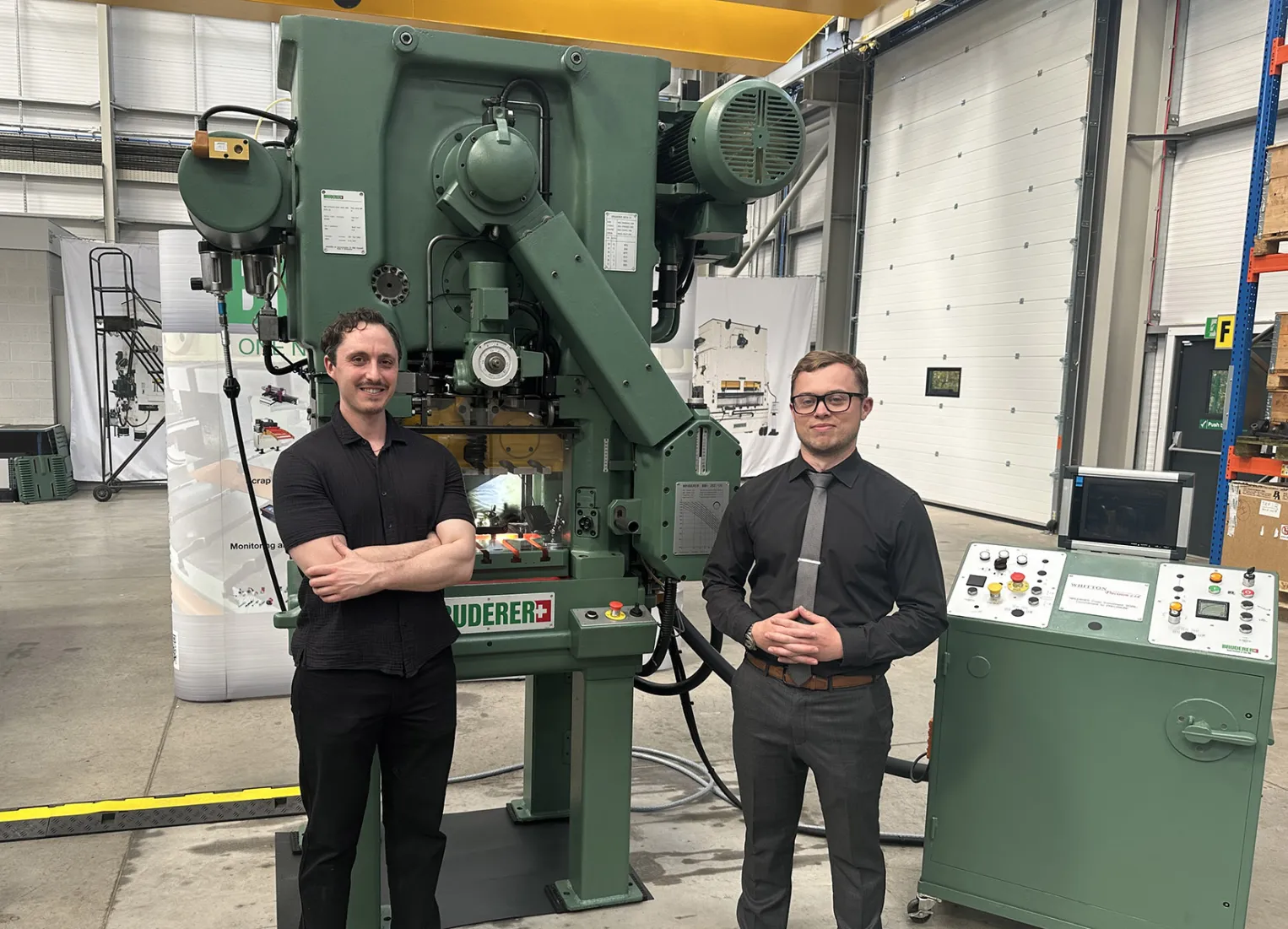
Whitton Precision Ltd, a family-owned specialist in precision pressed parts, has invested £120,000 in a Bruderer BSTA 25H high performance automatic punch press in a move set to increase production speeds and unlock capacity for new aerospace and defence projects.
Founded seventy-seven years ago by Leonard White and William Tonks, the Wimbledon-based company has quietly underpinned many of the biggest names in UK engineering and is the only surviving manufacturer of British standard crinkle washers.
Today, under the leadership of Len’s grandson Michael White, the business is combining its heritage with cutting-edge Bruderer UK technology to deliver critical components for clients ranging from FTSE 100 aerospace giants to diverse OEMs requiring custom-pressed parts.
“When some of our key plant was starting to show its age, we took the view that developing our capability was more advantageous than like-for-like replacement,” explained Michael.
“My desire to produce the ultimate precision pressings, at speed, led me to contact Bruderer UK. I sat down with the technical team and went through our production requirements.
“Importantly, we also took our most popular crinkle washer tool to Bruderer’s facility to prove it out on the BSTA 25H and we were blown away by the results, with production up to five times quicker than our old press.”
The Bruderer BSTA 25H delivers 25 tonnes of press force, a 530mm press bed, and stroke rates up to 1500 per minute.
Equipped with a BBV202 feeder and press and tool protection systems, the new line provides Whitton Precision’s skilled operators with real-time production data and ultimate control over quality.
“The machine is brilliant - coming from the world of C-frame presses, it’s in a different league,” continued Michael.
“When forming a precision component at bottom dead centre (BDC), precise control and repeatability of the ‘Ram’ shut height is critical. The BSTA 25H is outstanding when setting tools and runs all day without variance.
Founded by two young toolmakers who cut their teeth building the fighter planes of the second world war, Whitton Precision initially produced belt buckles, watch dials and ladies’ powder compacts.
Over the following years, the company evolved into a supplier of pressed industrial components with the Ford Motor Company and the MoD amongst its biggest clients.
With the third generation now at the helm, the Wimbledon factory is steadily being upgraded and the latest Bruderer machine will help it position itself as a leading supplier of UK-made, high-quality, precision pressed parts.
Photo: Michael White (Whitton Precision) with Scott Baker (Bruderer UK)
Image
Innovative robotics and additive manufacturing are transforming the future of fruit picking.
In a bid to address mounting challenges in the agricultural sector, Dogtooth Technologies, a UK-based agri-robotics company, is making waves with its intelligent, autonomous fruit harvesting robots. These cutting-edge machines, designed to work alongside human labourers, are rapidly gaining attention for their potential to revolutionise the picking of soft fruits such as strawberries and tomatoes.
Founded with the vision of tackling critical labour shortages, reducing food waste, and improving efficiency, Dogtooth’s mission resonates strongly at a time when the agriculture industry faces increasing pressure to optimise operations and secure food supply chains. The company’s robots promise to deliver a complete alternative to traditional human picking, combining state-of-the-art machine learning and computer vision technologies to identify, select, and harvest ripe fruits with near-human dexterity and care.
What sets Dogtooth’s robotic harvesters apart is their ability to autonomously navigate crop rows, locate and pick delicate berries without inflicting damage, and even inspect and package the fruit immediately after harvesting. This streamlined process eliminates the need for multiple handling stages, which can compromise fruit quality, and allows the robots to work efficiently during cooler overnight hours, thereby enhancing the shelf life of the produce. The result is a significant reduction in waste and a boost in productivity, offering tangible benefits to farmers grappling with staff shortages and the unpredictable demands of seasonal work.
The construction of these advanced robots reflects a sophisticated hybrid manufacturing approach. While Dogtooth incorporates standard, off-the-shelf components when feasible, the heart of their innovation lies in custom-engineered solutions. Among these, 3D printed parts play a pivotal role. Utilising vacuum casting for smaller production runs and 3D printing for complex, lightweight, and rapidly iterated components, the company has been able to push the boundaries of robotic performance and adaptability.
Key to this manufacturing success is a partnership with 3D People, a specialist in rapid additive manufacturing. Sasha Bruml and Felix Manley, founders of 3D People, have positioned their firm as an essential supplier for Dogtooth, providing bespoke polymer components on demand. Harnessing advanced powder bed fusion (PBF) technologies such as Selective Laser Sintering (SLS) and Multi Jet Fusion (MJF), 3D People enables Dogtooth to iterate quickly and deploy functional parts suitable for real-world testing. This agility ensures that Dogtooth can respond to the evolving challenges of agricultural environments while maintaining a reliable and cost-effective supply chain.
With short lead times and the ability to produce uniquely tailored components at scale, 3D printing is proving invaluable for Dogtooth’s ongoing development. As the technology matures, the collaboration between Dogtooth and 3D People shows how additive manufacturing is driving innovation in agri-tech, offering farmers practical solutions to industry-wide problems and paving the way for a smarter, more sustainable future in food production.
BACK TO ENGINEERING CAPACITY NEWS PAGE