
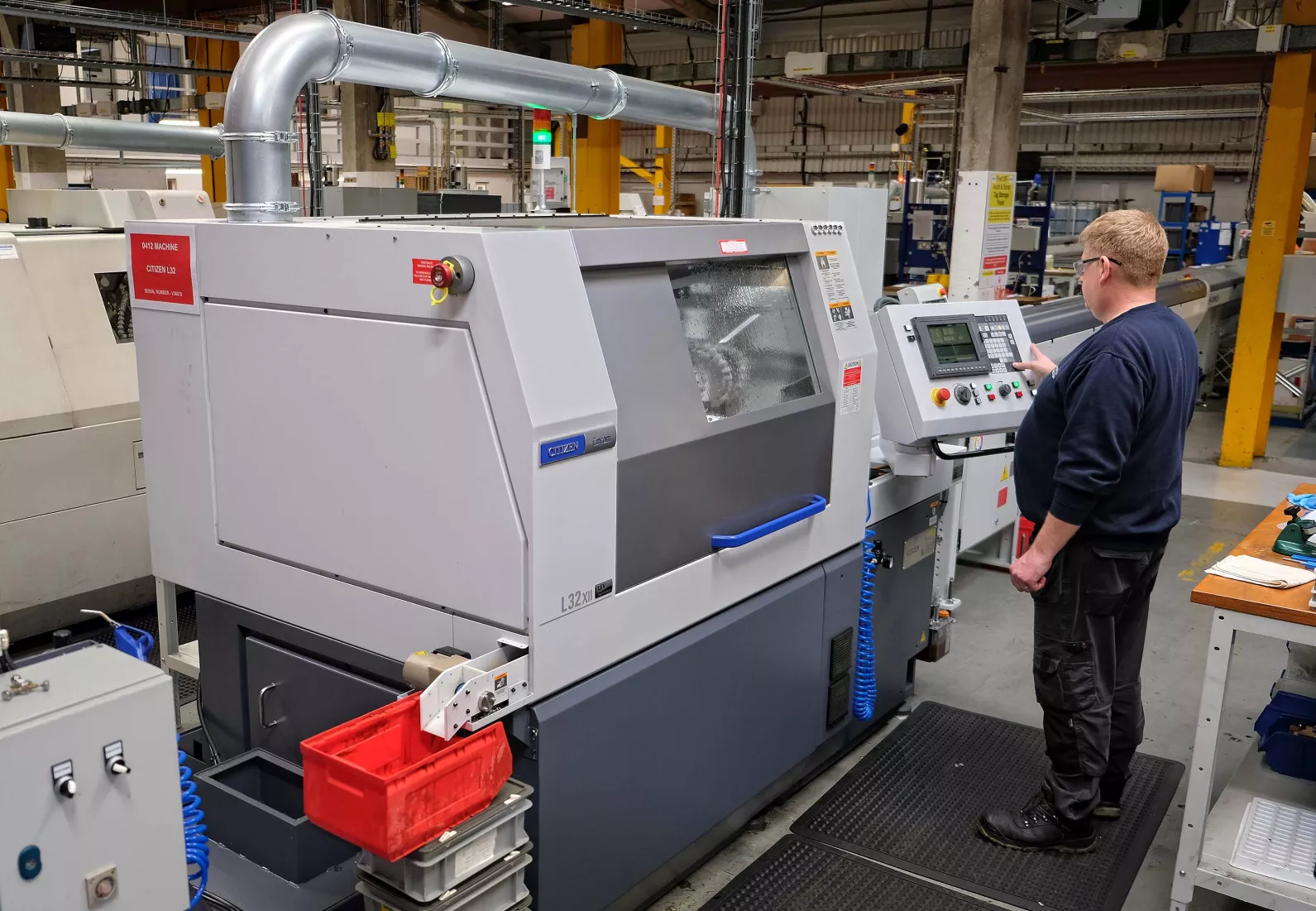
Metaltech Precision has more than doubled the number of sliding head mill/turn centres at its Chard facility.
This follows the purchase by the company’s owner Expromet Technologies Group of nearby subcontractor NC Precision.
Metaltech now has 13 of these machines on its shop floor, of which 10 are Citizen Cincom models.
The acquisition last year underlines the intention of the UK casting and machining group to strengthen its Swiss-type mill-turning capability. Nevertheless, Metaltech also offers fixed-head turning as well as prismatic metalcutting – with a total of 58 CNC machines.
The latest sliding-head lathe was installed in September 2022, having originally been ordered by NC Precision. It is a Cincom L32XIILFV capable of mill-turning parts from bar up to 35 mm diameter. Notably, the machine has LFV (low frequency vibration) functionality breaks up chips so that they fall away from the machining area.
Steven Ward, operations manager at Metaltech said, "We were already familiar with and impressed by LFV, having installed a smaller Cincom L20XIILFV four years ago to simplify the production of a particularly difficult component.
"The ongoing job involves machining a tough, malleable iron that has a high tendency to cause bird's-nesting when turned, but LFV completely solves the problem by allowing the chipping to be controlled.
"It means that we are able to leave the lathe running unattended for long periods, whereas before an operator needed to be in attendance virtually all the time to constantly clear away the swarf.”
The LFV function facilitates more options for fulfilling contracts that may come along involving titanium, nickel alloys or other metals that tend to result in stringy swarf.
Another area where the L32XIILFV has benefited Metaltech is in taking the load off a higher specification M-type 32 mm capacity Cincom on site that incorporates cutters in a turret. The gang tool-only L-type machine with its more nimble axis motions is quicker at producing relatively simple parts, leaving the M32 free to concentrate on more complex work.
One example was the transfer of production from the M32 to the L32 of a brass component on which only about 10% of the cycle involves turning operations, the remainder being milling and drilling. Although the spindle drives and driven cutter stations in the gang tool carrier lathe are a little less powerful than in the turret-type machine, it was nevertheless possible on the L-type lathe to produce the part from free-cutting brass in four minutes and four seconds, 20 seconds faster than on the M32.