
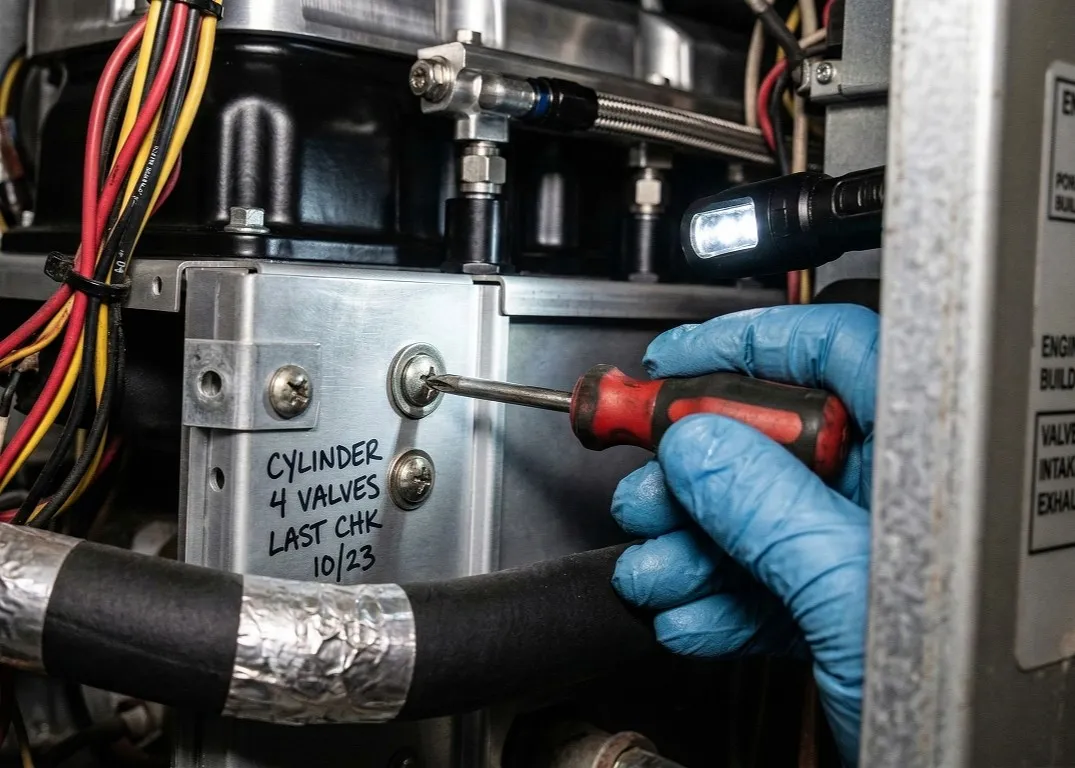
Patrick Faulkner, Lead Engineer at Accu, looks at how to select fasteners when working in confined spaces.
“Working in confined spaces is never straightforward. When access is limited, visibility is poor and movement is restricted, even small decisions about fastener choice can have significant consequences for assembly time, reliability and long-term performance.
There's no simple answer as to which fastener to use either. No single screw can be identified as the one that works best in every confined-space application. The right fastener depends on the specific challenges of the job, the function of the assembly, the practicalities of installation and the realities of maintaining components in places where you can barely see, let alone manoeuvre freely.
Managing clearance
Confined spaces place specific demands on both fastener design and installation method. What may seem small decisions, such as head profile or drive type, can have a significant impact once the assembly is enclosed and access is restricted. For example, a protruding screw head can interfere with moving parts, block airflow or prevent panels from seating flush.
Consider a machinery guard fitted inside a compact housing. On the bench, it may look straightforward, however once installed in situ, even a small protrusion from a pan or button head can create snag points or damage adjacent components during operation. Countersunk screws are often the answer here, as they can sit flush with the surface and eliminate secondary interference problems.
The same logic applies in electronics enclosures and control cabinets, where internal space is tightly managed around wiring, connectors and cooling paths. A raised screw head can obstruct cable routing or stress insulation, making low-profile fasteners preferable even where structural loads are minimal.
Drive type and tool access
Confined spaces rarely offer straight-line tool access. An engineer could be working at an angle, through a narrow gap, one-handed or at arm's length and in those conditions, conventional drive types quickly become a liability.
Slotted, Phillips and Pozi drives all require precise axial alignment to work properly. Without it, cam-out, damaged recesses and inconsistent tightening are a common result. Hex socket drives offer a more practical alternative. Allen keys can apply torque laterally, making it possible to drive screws even when direct access is blocked. Longer arms can reach into deep recesses without needing additional clearance around the head.
Where a specific drive type is required, Torx, for example, or security drives, a ratchet handle with a suitable bit provides similar benefits. The minimal swing arc allows controlled tightening in spaces where a full tool rotation simply is not possible.
Rotating and sliding components
Although access can cause issues, not every confined-space problem is about this. Some are about function. Rotating shafts, pulleys, collars and linear guides cannot tolerate any external protrusion from a fastener, regardless of how low-profile the head is.
Grub screws are a potential solution. Their headless design keeps everything within the envelope of the assembly and their internal drive allows adjustment and locking without introducing any external obstruction. That said, over-tightening or drive damage in these assemblies is difficult to correct once enclosed, which underlines the importance of controlled torque and the right tooling from the outset.
Handling multiple parts in a tight space
Dealing with issues with loose screws and washers in a confined space is one of the most common causes of delay and installation error. When an engineer is working inside a partially assembled enclosure with limited visibility, the last thing they need is two-handed juggling of separate components.
SEMS screws, which are pre-assembled captive screw-and-washer combinations, address this directly. By reducing the number of loose parts in play, they improve consistency and significantly reduce the chance of dropped components during assembly.
Where PPE is required, dexterity limitations add another layer of difficulty. Gloves make it harder to handle small tools and achieve precise alignment, especially with limited sightlines. Thumb screws remove the tool requirement entirely, allowing installation, adjustment and removal by hand. They are particularly useful for access panels, inspection covers and components that need regular attention.
However, thumb screws are not a universal solution. Hand-tightened by design, they cannot generate the clamping force needed for structural or load-critical joints, they are best suited to non-structural fastening and repeated-access situations. Adequate clearance around the fastener is also still required for hand operation.
Installing a screw where space is restricted requires specific tooling to assist. Stubby or offset screwdrivers can help where clearance is limited, while ratchet handles allow controlled tightening with minimal swing arc. For socket-driven fasteners, Allen keys are often effective as they allow torque to be applied laterally rather than directly in line with the screw.
Working with limited visibility
Where visibility is limited and it is safe to do so, initial thread engagement can be checked by touch before tightening to reduce the risk of cross-threading. In some cases, rivets may be considered instead of screws. Rivets can be installed with one-sided access and do not require thread alignment, making them suitable for enclosed panels or thin sheet materials. However, they are permanent fasteners and are best used where future disassembly is not required.
The choice between screws and rivets depends on whether the joint must remain removable, the degree of alignment control available and the practical constraints of access and visibility.
Selecting the right screw for a confined-space application is ultimately about reducing risk of error at every stage of the assembly process. Addressing this at an early stage minimises the need for maintenance and improves long-term reliability of fasteners in confined spaces.”