
For the second year running AI was the leading theme at machine tool manufacturer and laser specialist Trumpf’s recent INTEC in-house exhibition.
According to Trumpf, AI is changing the world of work and no industry or sector is unaffected and it is actively driving this change forward.
Last year at INTEC Trumpf showed two AI products, since then it has launched 10 more new AI products and product enhancements.
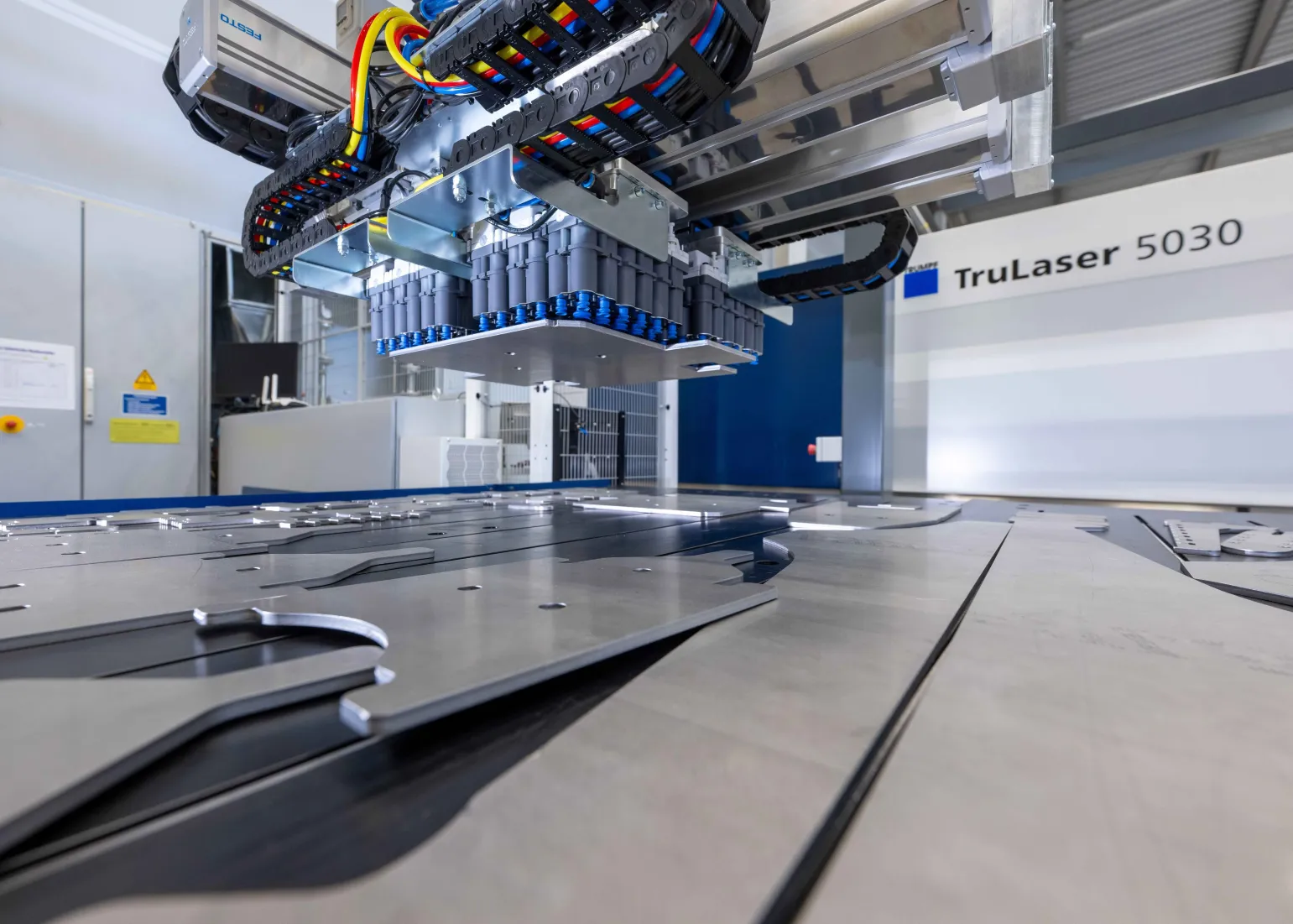
Stefan Mayer CEO of Trumpf Machine Tools explained that one of the major steps forward is the company’s SortMaster Vision system. This is an AI-based robot system that can sort parts coming off a 2D laser cutting machine without any programming.
“You simply program the machine to cut the part and everything else is done by AI algorithm and at the end you get the nicely sorted parts. Especially for thick parts this is a jump in innovation,” said Mr Mayer.
Another example of where AI delivers quality improvements is in laser cutting.
Mr Mayer explains that when laser cutting shifted from C02 lasers to solid state lasers there were compelling economic reasons for the move, but the actual cutting edge was not as good.
“The CO2 laser created a perfect edge but the move to solid state was driven by cost. You don’t need the CO2 gas, it’s three times more energy efficient. It was a technological shift, but the only disadvantage of these new lasers was that the edge was not as nice – it was a bit rough compared to the CO2 laser.
“Over the years we have tried to overcome this to get to a comparable quality level.”
He says that this depends on a lot of interacting parameters – the cutting gas, the speed, the laser power, the optical point where the laser enters the sheet and so on.
“It is very difficult to find optimum parameters because every sheet is different. Every day you have to adjust your parameters depending on the sheet you are using today – and that is impossible. AI now provides a solution which we are now offering, the Cutting Assistant.”
“To use it, production employees take a picture of their component’s cut edge with a hand scanner. The solution then assesses edge quality by evaluating for objective criteria such as burr formation. With this information, the Cutting Assistant's optimization algorithm suggests improved parameters for the cutting process. The machine then cuts the sheet metal once more. If the quality still does not meet expectations, the user has the option to repeat the process.”
According to Hagen Zimer, CEO of Laser Technology at Trumpf: “The whole topic of AI is hyping right now, but AI is just a tool. In the best case the AI is hidden tool working in the background to achieve something better for our customers.”
He highlighted one of the key areas where AI is being used as being in image and pattern recognition for quality control in the welding of electric motors and electronics – combining sensors with cameras to determine where the weld seam need to be located and what the best parameters are.
For example, in battery welding for electric cars an AI system can identify possible defects that can be repaired in the laser welding station. This enables users to reduce their manufacturing costs and reduce time-consuming quality inspections.
“We want to use AI to ensure quality on the shop floor,” says Mr Zimer. And for all this you need data. “The whole underlying prerequisite for this is data. Data from the process, data from the state of the machine or the laser, and so on, which is then combined to guide these processes on the shop floor. What we are striving for, our ambition, is that we want to eventually guarantee, by AI-assisted data mining and controls, to ensure quality on the shop floor.”
A key part of this is for customers to share their production data with Trumpf so that patterns can be identified and improvements found. This obviously requires a high degree of trust and Trumpf has been investing heavily in cyber security to provide this. 6000 machines are currently connected online providing process data in real time with performance managed proactively.
Mr Mayer is convinced that AI represents a big opportunity for Trumpf.
He says: “AI is an absolutely ‘must do’ for every tech company. We see a lot of commoditization in hardware worldwide – on machines, on lasers, on optics. So, the big next leap is how do we make these ‘stupid’ tools intelligent. AI is especially suited to give our hardware new things to differentiate it from other companies’ products.
“For example, AI is helping to make automation more robust. In the past when you talked about automation you were talking about programming a robot to always do the same thing. If the part is a little bit to the left or right the robot will grip in the wrong place. AI enables the robot to behave in a more failure tolerant way. The camera finds the part and if it is out of position the robot adjusts its movement and if it fails to grip the part it can have another go – so all these deterministic movements in automation can be developed much more robustly with AI and we can also get rid of the manual programming. That shouldn’t be the bottle neck of automation, particularly when it comes to high flexibility in parts variety. Without AI the programming effort is enormous every time you have a different part. It is a big, big step in automation.”
Photo: The SortMaster Vision uses AI to eliminate the need for programming from part removal and sorting.