
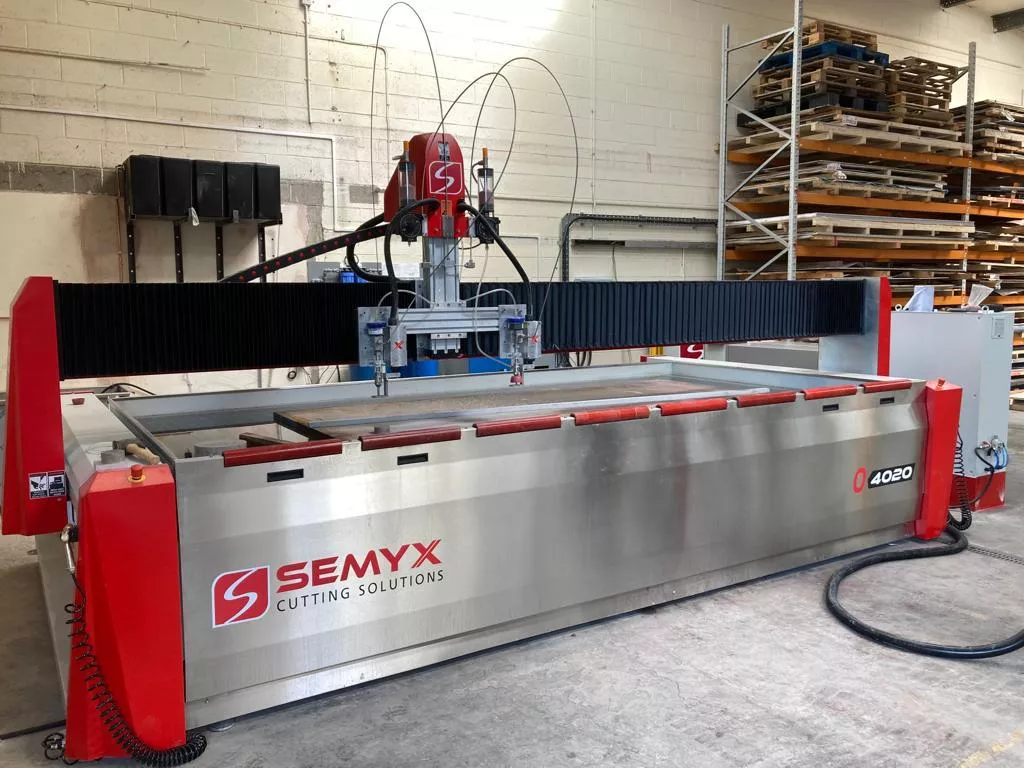
A new twin-head machine has doubled capacity at Q-Laser’s waterjet cutting department, removed a bottleneck and reduced lead times.
Before the investment in a Semyx Optima 420 twin abrasive waterjet cutting machine from Kerf Developments the department was approaching full capacity.
As a subcontract manufacturer, Q-Laser offers laser, waterjet, press brake and fabrication services throughout the UK. Located on the outskirts of Newcastle upon Tyne, Q-Laser provides its rapid-turnaround cutting services to the marine, offshore, automotive and general manufacturing sectors, cutting everything from exotics, stainless and mild steel to aluminium and armoured plate.
Founded in 2012, the company set up its waterjet cutting division in 2019 to complement its laser, press brake and fabrication services, starting with a 5-axis waterjet machine. Except for the pandemic, the waterjet division has grown rapidly, and the existing waterjet machine was struggling to meet the capacity demands of the business, so Q-Laser turned to Rochdale-based Kerf Developments for the solution.
With two cutting heads, the Optima 420 4m by 2m bed machine instantly doubled the cutting capacity in comparison to the existing machine. In a sector where clients expect a quotation in hours and components cut and delivered in less than a week, the addition of the machine has alleviated the bottleneck, created additional capacity and immediately reduced lead times.
Q-Laser Director Colin Hewitt said: “We set up the waterjet department for two reasons. Firstly, a laser is typically limited to cutting material up to 25mm thick. Secondly, unlike laser, waterjet cutting does not generate excessive heat that can impact the structural integrity of the material – this is of critical importance in aerospace, MoD and many automotive applications.”
As a company that manufactures anything from one-off to production runs for clients, machine uptime and productivity are as critical as cutting speed. The two cutting heads in the same machine footprint of the Optima 420 have slashed cycle times by more than 30%.
Unlike the cantilever design of the existing technology at Q-Laser, the Optima incorporates twin-sided drives that deliver excellent acceleration and machine kinematics as well as high precision.
Colin Hewitt added: “Some of our customers are machine shops that want pre-machined profiles. We can cut these to tight machining tolerances which means that many of our customers no longer need to rough machine their components.
“Our lead times can typically range from 24 hours to 7 days depending upon our workload. Before the arrival of the Optima, the lead times would extend beyond 10 days, so the machine has made a huge impact on our throughput. Additionally, we can fulfil our order book with fast turnaround for customers without putting demands on our staff to work around the clock.”