
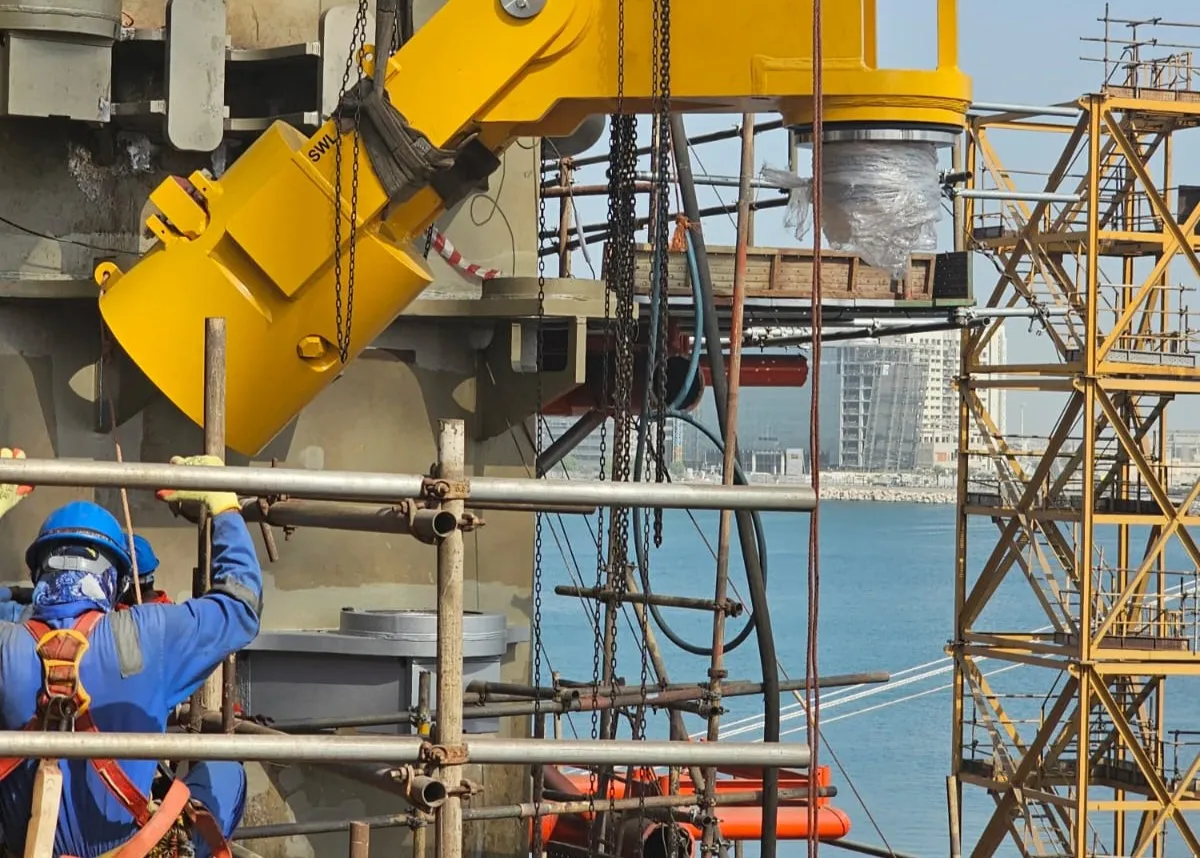
A Gloucestershire engineering company has drawn up plans for a new UK manufacturing facility that could create up to 40 skilled jobs and help supply the rapidly growing floating offshore wind sector in the Celtic Sea.
Gabriel Engineering Group Ltd has partnered with the National Manufacturing Institute Scotland (NMIS) to explore how specialist anchoring and mooring systems, essential components that secure floating offshore wind turbines to the seabed in deeper waters, could be manufactured competitively and at scale in the UK.
Supported through The Crown Estate’s £50 million Supply Chain Accelerator programme, the project explored how the UK could secure a greater share of the manufacturing, employment and economic benefits of floating offshore wind.
The work comes as the UK’s offshore wind supply chain is expected to contribute more than £18 billion to the economy over the next decade. With the Celtic Sea becoming one of Europe’s most promising regions for floating offshore wind, the project assessed how UK manufacturing capability could be developed to supply the specialist anchoring and mooring systems required to support future gigawatt-scale deployments.
NMIS worked with Gabriel Engineering to map how the systems could be manufactured efficiently and at scale, analysing materials, labour, equipment and production requirements. Using digital manufacturing models, production simulation and cost analysis, the team tested different production scenarios and identified what would be needed to establish a commercially viable UK manufacturing operation.
The project also considered where a new facility could be situated, assessing 10 potential port locations including Milford Haven, Port Talbot, Cardiff and Falmouth. Locations have now been identified for further engagement, based on factors including access to skilled labour, available land and infrastructure capable of handling heavy materials and finished products.
Gabriel Engineering also worked with Bardex Corporation to explore how its technologies could be produced through a modular manufacturing approach. Components would be manufactured and tested before final assembly, helping to identify technical issues earlier, reduce manufacturing risk and improve efficiency as production volumes increase.
The findings are now supporting Gabriel Engineering’s and Bardex’s investment and commercial planning, including discussions with The Crown Estate on the next phase of the project. If developed, the proposed facility could deliver up to 40 skilled jobs by 2028, support further employment across the regional supply chain and establish a new UK manufacturing base for critical floating wind infrastructure.
Jason Simeon, chief executive officer at Gabriel Engineering, said: “Our collaboration with NMIS has been a turning point for Gabriel Engineering. By focusing on a modular process approach, we’ve been able to integrate these high-performance products into a system designed for the factory of the future. We have created a better production process that removes the inherent risks associated with large-scale fabrication, enabling us to deliver at the pace required by the offshore wind market.”