
Leaving a 20-year clinical career for product design took confidence and the right partners. Damian Pendlebury’s vision, combined with MGS Technical Group’s toolmaking and injection-moulding expertise, helped two North West businesses turn a sidelineinto 40,000 annual sales.
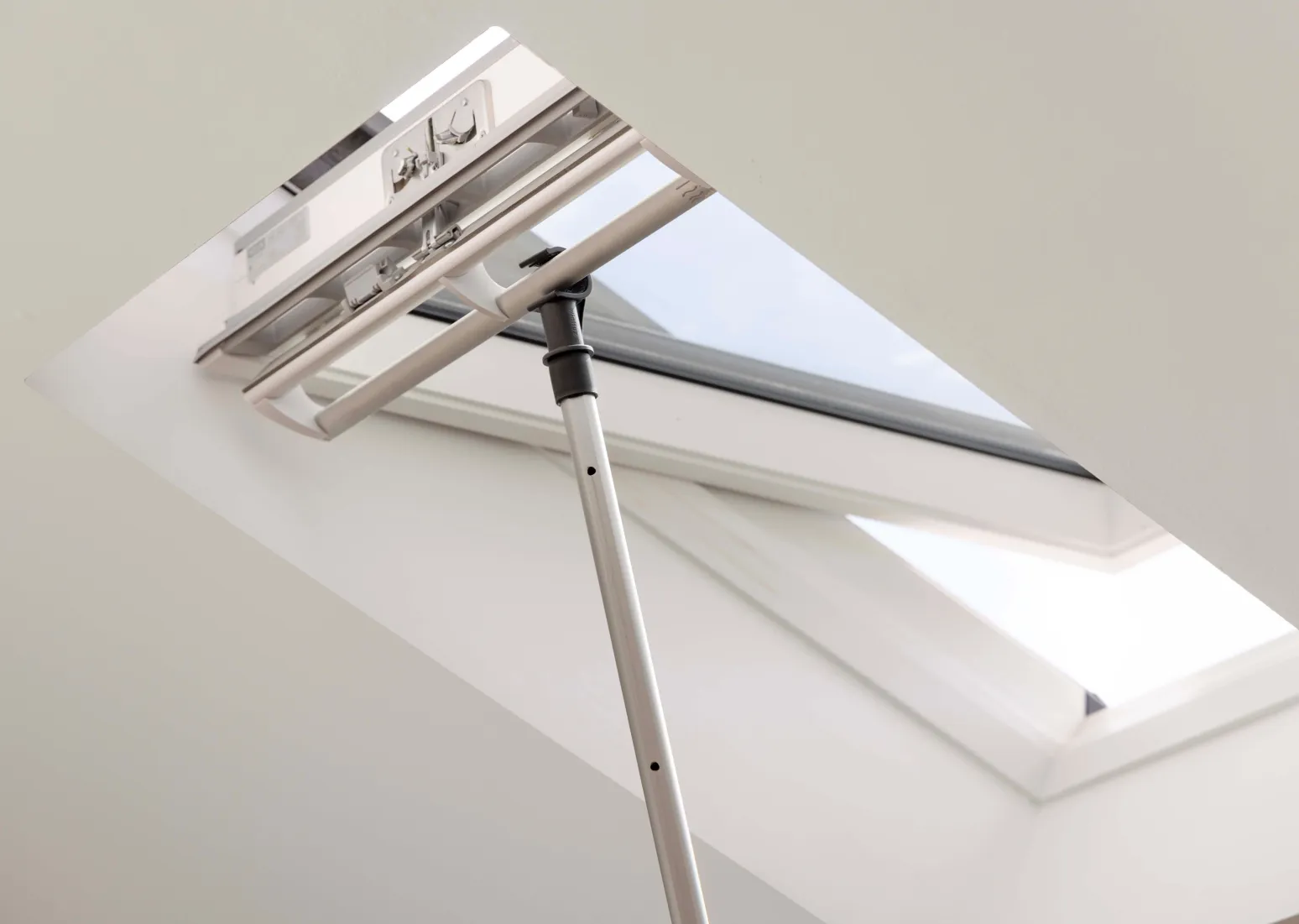
In 2017, frustrated by the sales-led nature of optometry, Damian taught himself CAD and designed a stronger, more versatile extendable window-pole hook. When early production runs proved inconsistent, he moved manufacturing to MGS Technical Group in Lancashire.
Together, they developed a hook built to handle demanding loads and backed by Damian’s five-year guarantee. Sold exclusively on Amazon, WinHux is on course to reach 40,000 sales a year.
With MGS’s support, Damian now plans to expand into wholesale DIY channels without compromising on high-quality, locally made components.
Looking for a way out of optometry, Damian first developed a customised ophthalmoscope battery. It was too niche to support a business, but the experience confirmed his interest in product design. A relative’s success on Amazon then encouraged him to look for a broader market.
His Amazon research revealed strong demand for skylight window poles, despite poor reviews of their durability and ease of use. Damian saw an opportunity, designed an alternative and left optometry within six months.
“Launching a product is one thing; scaling it for mass production is another challenge entirely,” Damian said.
Damian chose local manufacturing to protect his intellectual property and keep technical decisions close at hand. With MGS only 40 minutes away, he also avoided many of the logistical risks of working overseas.
MGS then set about resolving the main manufacturing issues.
Satisfaction over sales
Rather than use recycled regrind or lower-grade plastics, MGS specified virgin nylon 6 reinforced with 30% glass fibre. “A standard window requires only 20kg of force, but the WinHux hook supports more than 150kg,” said Chloe Maine, Business Development Manager at MGS.
For Damian, long-term customer satisfaction mattered more than replacement sales caused by breakages. A non-slip surface, universal ACME thread and robust construction position WinHux as a premium product.
MGS shared that approach from the outset. “In a market where customers are used to being disappointed, a UK-made product that lasts for decades is a real point of difference,” Chloe said.
Local manufacturing
Apart from the extendable poles, Damian kept production in the UK to protect the design and retain technical knowledge.
That mattered because the hook is more complex than it first appears. Its threaded sections are intricate and must be moulded with consistent precision.
Making the components and packaging in the UK also gave WinHux control over final assembly. It reduced the uncertainty of offshore shipping and allowed Damian to oversee quality at every stage.
“Meeting in person helped us resolve tooling and manufacturing problems quickly,” Damian said. “With technical components, working nearby can be faster and more cost-effective than dealing across time zones.”
The value of that proximity became clear after the first moulding attempts produced weak, inconsistent parts.
MGS stabilised production with a 1+1 cavity tool, moulding the hook and its matching component in the same cycle to give both consistent material properties. Regular in-house servicing helps ensure the 40,000th part performs like the first.
Damian said MGS matched his commitment to the long-term performance of both the tool and the finished part. “They were invested in the project’s future and in maintaining quality and reliability throughout development.”
For Chloe, WinHux shows what high-quality local manufacturing can achieve. “Innovators like Damian show that even a small business can make a meaningful impact by investing in manufacturing quality and a local supply chain.”
MGS Technical Group offers a full end-to-end service and has dedicated teams that support innovators and OEMs through each stage of concept to commercialisation. “Manufacturing any component is a multi-stage process where success depends on matching specific, often highly technical skills to each phase. Every stage of the journey is different and in-house support for each element is an enabling factor to reduce risk and get products to market faster,” said Chloe.